
Through the Eyes of the Inhabitant of the Holy See
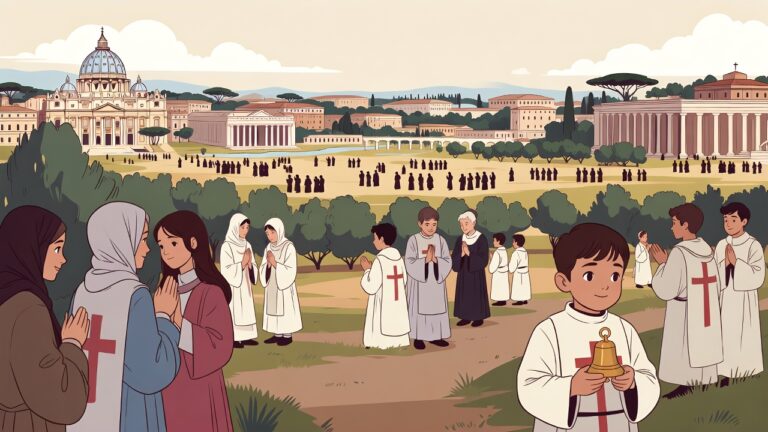
The first thing you hear as morning breaks over Saint Peter's Square is the soft, deep tolling of one of the bells in Saint Peter's Basilica, mingled with the distant whisper of prayers and the lingering scent of incense from early Mass. That bell toll carries our story back to a time of eternal rock and faith, when we lived as the community around the successor of Peter, the first whom Christ called “rock”. Our ancestors built basilicas that seemed to touch the sky, wrote manuscripts that enlightened the world, honoured the apostles with prayers and rituals. We lived in harmony with history as mother and heaven as father: priests who celebrated Mass in Latin, pilgrims who came from every corner of the world, communities where faith and service were law. Every family knew the stories of Peter, the letters of Paul, the sacraments that sanctified life. That was our golden time: a city-state of faith and art, where people lived with the Church as guide and eternity as horizon, connected by prayer and grace.
But then came the wave from outside, like a storm rising from history. Roman emperors persecuted us, barbarians plundered Rome, the Middle Ages brought schisms and crusades, the Reformation tore unity apart. The French Revolution took our Papal States, Mussolini and Napoleon seized our land, and in 1870 Rome was taken by the new Italy. Every family knew the loss: an ancestor who lived in exile, a church that was closed, a faith that had to survive in shadow. The smell of smoke from burning manuscripts, the silence after plunder, the emptiness in the streets of Rome.
From that depth rises a pride that is quiet and eternal. Saint Peter's Basilica that still stands, the Sistine Chapel with Michelangelo's heaven, the Pope who speaks for billions. Our artists – from Bernini to Caravaggio – who gave the world beauty, our diplomacy that seeks peace, our people who pray for all. We have found our voice again: the Lateran Treaties in 1929 that made us a state once more, the messages of hope from John XXIII and Francis.
Yet the truth colours magenta like a sunset over Saint Peter's Square. The scars remain: the memory of schisms, scandals that sometimes return, the pressure of a world changing faster than tradition. The outside world often looks with judgment – they see pomp and splendour, but do not feel the depth of a people that always rises again in prayer.
Still, we remember in silence: on Saint Peter's Square where thousands pray, on Easter Sunday when the urbi et orbi rings out, in the basilica where candles burn – never forgetting who we were. We tell our children of Peter and of Francis, of the basilica and the river, so they know: we were connected and holy before we were challenged.
And yet… the bell toll continues, soft and persistent, like a promise that the rock never wavers. That is our secret: we have suffered under persecution, schisms and changes, but first we were a city of faith and eternity. For our children we build no walls, but a square where everyone may pray. How do we let that bell toll bring hope to all once more, how does the Holy See remain a home of peace and grace?
January 2026
Manna Ori
Attraverso gli occhi dell’abitante della Santa Sede
La prima cosa che senti quando il mattino sorge su piazza San Pietro è il suono dolce e profondo di una delle campane della Basilica di San Pietro, mescolato al sussurro lontano delle preghiere e all’odore persistente dell’incenso della Messa mattutina. Quel suono di campane porta la nostra storia indietro a un tempo di roccia eterna e fede, quando vivevamo come comunità intorno al successore di Pietro, il primo che Cristo chiamò “roccia”. I nostri antenati costruirono basiliche che sembravano toccare il cielo, scrissero manoscritti che illuminarono il mondo, onorarono gli apostoli con preghiere e riti. Vivevamo in armonia con la storia come madre e il cielo come padre: sacerdoti che celebravano la Messa in latino, pellegrini che arrivavano da ogni parte del mondo, comunità dove fede e servizio erano legge. Ogni famiglia conosceva le storie di Pietro, le lettere di Paolo, i sacramenti che santificavano la vita. Era il nostro tempo d’oro: una città-stato di fede e arte, dove le persone vivevano con la Chiesa come guida e l’eternità come orizzonte, connesse dalla preghiera e dalla grazia.
Ma poi arrivò l’onda dall’esterno, come una tempesta che si levava dalla storia. Gli imperatori romani ci perseguitarono, i barbari saccheggiarono Roma, il Medioevo portò scismi e crociate, la Riforma lacerò l’unità. La Rivoluzione francese ci tolse gli Stati Pontifici, Mussolini e Napoleone afferrarono le nostre terre, e nel 1870 Roma fu presa dal nuovo Regno d’Italia. Ogni famiglia conosceva la perdita: un antenato che visse in esilio, una chiesa che venne chiusa, una fede che dovette sopravvivere nell’ombra. L’odore di fumo da manoscritti bruciati, il silenzio dopo i saccheggi, il vuoto nelle strade di Roma.
Da quella profondità sale un orgoglio silenzioso ed eterno. La Basilica di San Pietro che ancora sorge, la Cappella Sistina col cielo di Michelangelo, il Papa che parla per miliardi. I nostri artisti – da Bernini a Caravaggio – che diedero bellezza al mondo, la nostra diplomazia che cerca pace, la nostra gente che prega per tutti. Abbiamo ritrovato la nostra voce: i Patti Lateranensi del 1929 che ci resero di nuovo uno Stato, i messaggi di speranza di Giovanni XXIII e Francesco.
Eppure la verità si tinge di magenta come un tramonto su piazza San Pietro. Le cicatrici restano: il ricordo degli scismi, gli scandali che a volte ritornano, la pressione di un mondo che cambia più veloce della tradizione. Il mondo esterno spesso guarda con giudizio – vede pompa e splendore, ma non sente la profondità di un popolo che risorge sempre nella preghiera.
Tuttavia ricordiamo in silenzio: su piazza San Pietro dove migliaia pregano, la Domenica di Pasqua quando risuona l’urbi et orbi, nella basilica dove ardono le candele – senza mai dimenticare chi eravamo. Raccontiamo ai nostri figli di Pietro e di Francesco, della basilica e del fiume, affinché sappiano: eravamo uniti e santi prima di essere messi alla prova.
Eppure… il suono delle campane continua, dolce e persistente, come una promessa che la roccia non vacilla mai. Questo è il nostro segreto: abbiamo sofferto sotto persecuzioni, scismi e cambiamenti, ma prima eravamo una città di fede ed eternità. Per i nostri figli non costruiamo mura, ma una piazza dove tutti possano pregare. Come facciamo risuonare quel suono di campane per portare speranza a tutti ancora una volta, come la Santa Sede resta una casa di pace e grazia?
Gennaio 2026
Manna Ori