Through the Eyes of the I-Kiribati
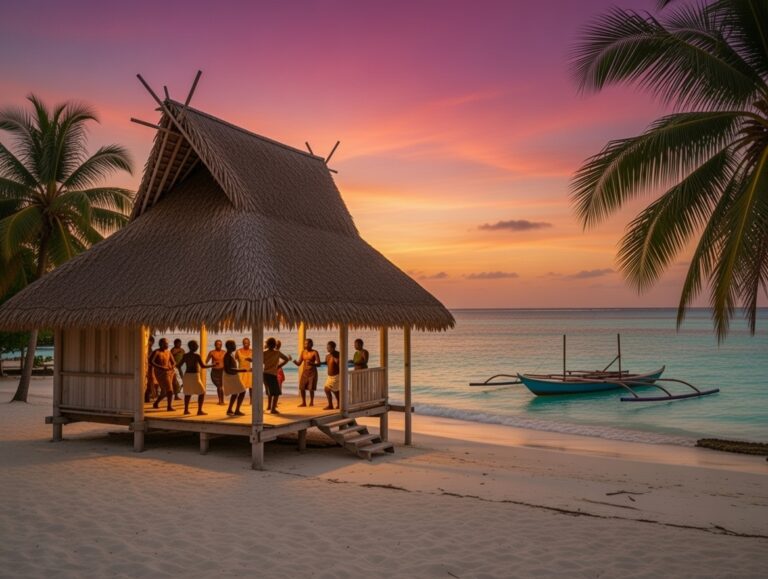
The first thing you hear as morning comes over an atoll of Kiribati is the soft, endless sound of the oceanbreaking against the coral reefs, blending with the distant call of a frigatebird and the scent of fresh coconut androasted fish drifting from a nearby home. That wave murmur carries our story back to a time of islands andinfinite horizon, when we lived as the I-Kiribati on these scattered atolls we call Kiribati. Our ancestors builtmaneaba halls from coconut palms and thatch, fished with outrigger canoes in turquoise lagoons, cultivated taroin the fertile island soil. They lived in harmony with the sea as mother and the sun as father: navigators who readthe stars to voyage between islands, te mwaneaba dances that filled the night with rhythm, communities wheresharing was normal and respect for elders was law. Every family knew the stories of the gods, the navigationsongs passed through generations, the bond stronger than the distance between atolls. That was our goldentime: a nation of 33 atolls and reefs, where people lived with the ocean as road and the stars as guide, free andconnected through sea and community.
But then came the wave from outside, like a hurricane rising from the ocean. The British colonized us in the 19thcentury, called us the Gilbert Islands and made us a protectorate. They divided our land, imposed their laws,tried to break us. Every family knew the loss: an ancestor who labored for strangers, a culture that had to survivealongside English, a connection stretched across oceans. Independence in 1979 brought hope with IeremiaTabai, but also the challenges of a small island nation: warming seas threatening the atolls, rising sea levelsswallowing villages, the emigration of youth to Fiji and New Zealand because the future sometimes liesunderwater. Every family knew the fear, the displacement by waves, the silence on the beaches.
From that depth rises a pride that is warm and resilient. The te mwaneaba dances that still fill the night, thecoconut that gives us everything, the navigation knowledge that still lives. Our people who laugh throughhardships, our youth dreaming of a future on higher ground, our bond stronger than the sea. We have found ourvoice again: the calls to the world for climate action, the hope that never drowns.
Yet the truth colors magenta like a sunset over the lagoon. The scars remain: rising seas swallowing islands,poverty on remote atolls, the emigration of youth, the memory of colonial times. The outside world buys our fishand our tourism, but often does not feel the depth of a people literally fighting against the waves.
Still, we remember in silence: around the maneaba where stories are told, on Independence Day on July 12when we raise our flag, on the beaches where the spirits still speak—we never forget who we were. We tell ourchildren of the ancient navigators and of Tabai, of the sea and the atolls, so they know: we were connected andstrong before we were challenged.
And yet… the wave murmur continues, calm and endless, like a promise that the sea always returns. That is oursecret: we have suffered under colonization, rising seas, and uncertainty, but first we were a land of atolls andnavigation. For our children we build no walls, but a canoe where everyone may paddle along. How do we letthat wave murmur bring hope to everyone again? How does Kiribati remain a home of sea and resilience?
January 2026
Manna Ori