
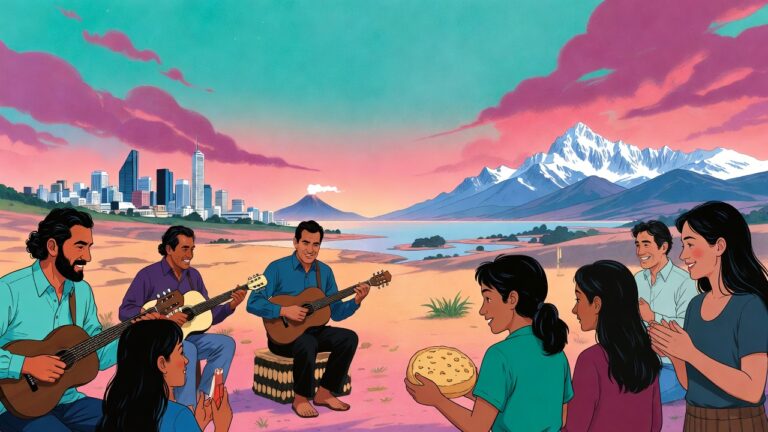
Through the Eyes of the New Zealander
The first sound you hear as morning arrives over Auckland is the soft, rhythmic blast of a pūtātara (conch shell trumpet) sounding once from a nearby marae, mingled with the distant call of a kiwi in the bush and the scent of fresh rewena bread and manuka honey drifting from a nearby home. That conch-sound carries our story back to a time of islands and waka, when we lived as the Māori and later the Pākehā who together formed Aotearoa. Our ancestors voyaged across the Pacific in waka, built marae where stories were told, grew kūmara and fern root in fertile soil. The Māori knew their whakapapa (genealogy), the haka that showed strength, communities where mana (respect) and kaitiakitanga (guardianship of the land) were the law. Every family knew the legends of Maui who fished up the North Island, the feasts of Matariki marking the new year, the bond stronger than the sea. That was our golden time: a land of fjords, volcanoes, and forests, where people lived in harmony with nature as mother and ancestors as father, connected by waka and whakapapa.
But then came the wave from outside, like a storm rising from the sea. The British colonized us in the 19th century, signed the Treaty of Waitangi in 1840 – a promise of partnership that was often broken. Land was taken, wars followed in the 1860s, Māori became marginalized in their own land. Every family knew the loss: an ancestor who fought in the New Zealand Wars, a child who learned their language was forbidden at school, a culture held in secret. The 20th century brought emigration, racism, the Springbok tour protests in 1981 that divided our nation. Every family knew the pain, the struggle, the silence in the villages.
From that depth rises a pride that is warm and resilient. The haka that still makes the world tremble, the hangi prepared with love, the kiwi that runs free in the bush. Our people laughing through hardship, our youth rising for a better land, our bond stronger than history. We have found our voice again: the Waitangi Tribunal that seeks to redress wrongs, the recognition of te reo Māori as an official language, hope growing in the marae.
Yet the truth colors magenta like a sunset over the Southern Alps. The scars remain: land losses that still echo, poverty in some iwi, emigration of youth, pressure of climate change on our coasts. The outside world buys our tourism and our lamb, but often does not feel the depth of a people who never broke.
Still, we remember in silence: around the marae where stories are told, during Waitangi Day on 6 February when we raise our flag, in the forests where the spirits still speak – never forgetting who we were. We tell our children of Maui and of the Waitangi Tribunal, of the sea and the mountains, so they know: we were connected and strong before we were challenged.
And yet… the pūtātara continues, sharp and persistent, like a call drifting over the islands. That is our secret: we have suffered under colonization, injustice, and change, but first we were a land of waka and connection. For our children we build no walls, but a marae where everyone is welcome. How do we let that conch-sound bring unity to everyone again? How does New Zealand remain a home of respect and hope?
January 2026
Manna Ori
Ki ngā Karu o te Tangata Whenua o Aotearoa
Ko te oro tuatahi ka rongo koe i te ata ka tae mai ki runga o Tāmaki Makaurau ko te oro ngawari, whai tikanga o te pūtātara e whakatangi ana kotahi te wā mai i te marae tata, whakakotahitia ki te karanga tawhiti o te kiwi i te ngahere me te kakara o te rewena hou me te miere manuka e rere mai ana i tētahi whare tata. Ko taua oro pūtātara e kawe ana i tō mātou kōrero hoki ki te wā o ngā moutere me ngā waka, i te wā i noho ai mātou hei iwi Māori me muri mai ko ngā Pākehā i hanga tahi i a Aotearoa. Ko ō mātou tūpuna i hoe i ngā waka puta noa i te Moana-nui-a-Kiwa, i hanga marae hei wāhi kōrero kōrero, i whakatupu kūmara me te aruhe i te whenua momona. I mōhio ngā Māori ki tō rātou whakapapa, te haka e whakaatu ana i te kaha, ngā hapori i reira ko te mana me te kaitiakitanga te ture. I mōhio ia whānau ki ngā pūrākau o Māui i hī ake te Ika-a-Māui, ngā hui o Matariki i timata ai te tau hou, te here e kaha ake ana i te moana. Ko tēnei tō mātou wā koura: he whenua o ngā fjord, ngā puia me ngā ngahere, i noho ai te tangata i runga i te rongo ki te taiao hei whaea me ngā tūpuna hei matua, i herea e te waka me te whakapapa.
Engari kātahi ka tae mai te ngaru mai i waho, he āwha e ara ake ana i te moana. I whakatōpū te Pākehā i a mātou i te rautau 19, i hainatia te Tiriti o Waitangi i te 1840 – he oati mo te whakahoatanga i takahia pinepine. I tangohia te whenua, i whai muri ngā pakanga i ngā tau 1860, i noho iti ngā Māori i tō rātou ake whenua. I mōhio ia whānau ki te ngaronga: he tūpuna i whawhai i ngā Pakanga o Aotearoa, he tamaiti i ako he aukati te herekoretanga, he ahurea i tiakina huna. I kawea mai te rautau 20 te heke, te kaikiri, ngā porotēhi o te haerenga Springbok i te 1981 i wehewehe ai tō mātou whenua. I mōhio ia whānau ki te mamae, te pakanga, te noho puku i ngā kāinga.
Mai i tēnā hōhonu ka ara ake he whakamana hōhonu me te manawanui. Ko te haka e wiri tonu ana i te ao, te hangi i mahia me te aroha, te kiwi e oma noa ana i te ngahere. Ko ō mātou iwi e kata ana i roto i ngā uauatanga, ō mātou rangatahi e whakatika ana mō tētahi whenua pai ake, ō mātou here e kaha ake ana i te hitori. Kua kitea anō tō mātou reo: te Taraipiunara o Waitangi e whakatika ana i ngā hē, te whakaaetanga o te reo Māori hei reo whai mana, te tūmanako e tupu ana i ngā marae.
Heoi anō, he magenta te pono pērā i te tānga o te rā ki runga o ngā Maunga Tongariro. Kei reira tonu ngā whiu: ngā ngaronga whenua e tangi tonu ana, te rawakore i ētahi iwi, te heke o ngā rangatahi, te pēhanga o te huringa āhuarangi ki ō mātou takutai. Ka hokona e te ao o waho ō mātou haerenga me ō mātou hipi, engari kāore e rongo pinepine ki te hōhonu o tētahi iwi kāore i whati.
Heoi anō, e maumahara tonu ana mātou i te puku: huri noa i te marae e kōrerotia ai ngā kōrero, i te Rā o Waitangi i te 6 o Hui-tanguru ka whakaarahia tō mātou haki, i ngā ngahere e kōrero tonu ana ngā wairua – e kore e warewaretia ko wai mātou. Ka kōrero mātou ki ā mātou tamariki mō Māui me te Taraipiunara o Waitangi, mō te moana me ngā maunga, kia mōhio ai rātou: i herea mātou, i kaha mātou i mua i te wero.
Ā, heoi anō… kei te haere tonu te pūtātara, koi me te manawanui, he karanga e rere ana i runga i ngā moutere. Koinei tō mātou mea huna: i mamae mātou i raro i te whakatōpūtanga, te tūkino me te panoni, engari i te tuatahi he whenua waka me te here mātou. Mō ā mātou tamariki e kore mātou e hanga taiepa, engari he marae e tūwhera ana ki te katoa. Me pēhea e kawe ai tēnā oro pūtātara i te kotahitanga ki te katoa anō? Me pēhea e noho tonu ai a Aotearoa hei kāinga o te mana me te tūmanako?
Hui-tanguru 2026
Manna Ori