Through the Eyes of the Seychellois
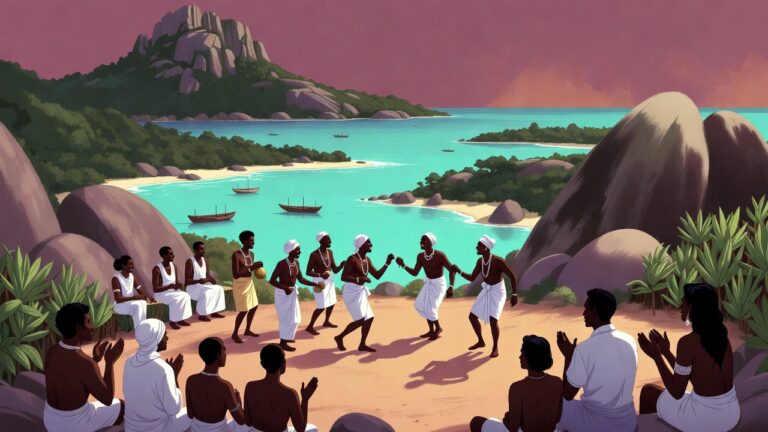
The first sound you hear as morning arrives over Mahé is the soft, endless rhythm of waves breaking against the coral reef, mingled with the distant call of a tropical bird and the scent of fresh coconut and grilled fish drifting from a nearby home. That wave-whisper carries our story back to a time of islands and infinite horizons, when we lived as the Seychellois – a mix of African enslaved, French settlers, Indian and Chinese laborers who together formed the Creole culture. Our ancestors built small wooden and palm houses on the beaches, fished with pirogues in turquoise lagoons, grew coconut and vanilla in fertile soil. They lived in harmony with the sea as mother and the granite rocks as father: fishermen who honored the ocean with prayers, families telling stories in Creole, communities where sharing was natural and respect for elders was the law. Every family knew the legends of sea spirits, the feasts of Creole Festival where everyone danced the moutya, the bond stronger than the distance between the islands. That was our golden time: an archipelago of 115 islands, where people lived with the ocean as road and the stars as guide, free and connected by Creole rhythm and hospitality.
But then came the wave from outside, like a storm rising from the Indian Ocean. The French colonized us in the 18th century, the British took over in 1814, turned us into a plantation colony of cinnamon, vanilla, and copra. Enslaved people were shipped from Africa and Madagascar, their backs broken under the sun, their spirits smothered but never killed. Every family knew the loss: an ancestor who arrived in chains, a language that had to survive in secret, a culture that blended to endure. Independence in 1976 brought James Mancham and France-Albert René – hope that grew – but also a coup in 1977, political tensions, and the challenges of a small island nation: poverty, emigration of youth, pressure of climate change threatening our coasts and coral reefs.
From that depth rises a pride that is warm and resilient. The moutya dance that still fills the night, the coconut that gives us everything, the Creole language that connects everyone. Our people laughing through hardship, our youth dreaming of a future on the islands, our bond stronger than the sea. We have found our voice again: democracy growing, hope that never drowns.
Yet the truth colors magenta like a sunset over Anse Source d’Argent. The scars remain: memory of slavery, rising sea threatening atolls, emigration of youth, poverty on remote islands. The outside world buys our tourism and our vanilla, but often does not feel the depth of a people literally fighting against the waves.
Still, we remember in silence: around the moutya where dancing sounds, during Independence Day on 29 June when we raise our flag, on the beaches where the spirits still speak – never forgetting who we were. We tell our children of the old enslaved and of Mancham, of the sea and the islands, so they know: we were connected and strong before we were challenged.
And yet… the wave-whisper continues, calm and endless, like a promise that the sea always returns. That is our secret: we have suffered under colonization, slavery, and rising seas, but first we were a land of islands and rhythm. For our children we build no walls, but a beach where everyone may dance. How do we let that wave-whisper bring hope to everyone again? How does Seychelles remain a home of Creole connection and resilience?
January 2026
Manna Ori