
Through the Eyes of the Slovak
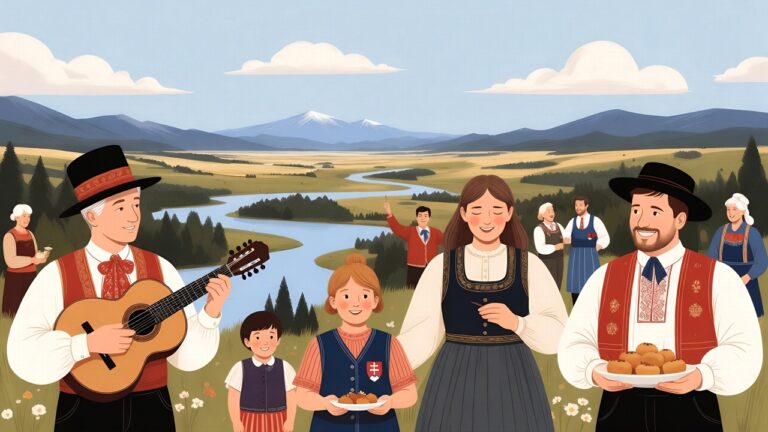
The first sound you hear as morning arrives over Bratislava is the soft, deep note of a fujara (long shepherd's flute) blowing a single tone, mingled with the distant tolling of church bells and the scent of fresh bryndzové halušky (potato dumplings with sheep cheese) drifting from a nearby home. That flute-sound carries our story back to a time of mountains and valleys, when we lived as the people of Slovakia. Our ancestors built castles on the hills like Spiš and Orava, grew wheat and flax in fertile plains, herded sheep in the High Tatras. They lived in harmony with the Carpathians as mother and the Danube as father: shepherds who played their fujara to call the flock, families telling stories of Juraj Jánošík the Robin Hood of the Tatras, communities where hospitality was sacred and the bond stronger than time. Every family knew the legends of the Tatra gods, the feasts of Vianoce where candles burned, the pride in a language preserved for centuries. That was our golden time: a land of mountains, rivers, and forests, where people lived with nature as guide and freedom as promise, connected by song and land.
But then came the wave from outside, like a cold wind that blew for centuries. The Hungarians ruled us for a thousand years, tried to make us Hungarian, tried to smother our language. The Habsburgs held us in their grip, Czechoslovakia after 1918 brought hope but also annexation by Nazi Germany in 1939, communist dictatorship after 1948 with repression and collectivization. Every family knew the loss: a grandfather who fought in the war, an uncle who vanished in prison, a child who learned freedom was forbidden. The Velvet Revolution in 1989 brought freedom, the peaceful split of Czechoslovakia in 1993 brought uncertainty. Every family knew the pain, emigration to the West, the silence in the villages.
From that depth rises a pride that is deep and sober. The fujara that still plays in the mountains, the bryndzové halušky prepared with love, the Tatras that protect us. Our people working hard and laughing through difficulties, our youth rising for a better land, our bond stronger than history. We have found our voice again: democracy, EU accession in 2004, hope growing in the valleys.
Yet the truth colors magenta like a sunset over the High Tatras. The scars remain: memory of domination, emigration of youth, poverty in the mountain villages, pressure of a fast-changing world. The outside world buys our tourism and our beer, but often does not feel the depth of a people who never broke.
Still, we remember in silence: around the fujara where music is made, during Independence Day on 1 January when we raise our flag, in the mountains where the spirits still speak – never forgetting who we were. We tell our children of Jánošík and of the Velvet Revolution, of the river and the mountains, so they know: we were connected and strong before we were challenged.
And yet… the fujara continues, high and clear, like a promise drifting over the mountains. That is our secret: we have suffered under domination, oppression, and change, but first we were a land of mountains and song. For our children we build no walls, but a mountain path where everyone may walk. How do we let that flute-sound bring freedom to everyone again? How does Slovakia remain a home of silence and resilience?
January 2026
Manna Ori
Očami Slováka
Prvý zvuk, ktorý počuješ, keď ráno prichádza nad Bratislavu, je jemný, hlboký tón fujary, ktorá zahrá jednu nôtu, zmiešaný s vzdialeným zvonmi kostolných zvonov a vôňou čerstvých bryndzových halušiek, ktorá sa šíri z blízkeho domu. Tento zvuk fujary nesie náš príbeh späť do čias hôr a dolín, keď sme žili ako ľud Slovenska. Naši predkovia stavali hrady na kopcoch ako Spiš a Orava, pestovali pšenicu a ľan na úrodných rovinách, pásli ovce vo Vysokých Tatrách. Žili v harmónii s Karpatmi ako matkou a Dunajom ako otcom: pastieri, ktorí hrali na fujare, aby zavolali stádo, rodiny, ktoré rozprávali príbehy o Jurajovi Jánošíkovi, robinhoodovi Tatier, komunity, kde pohostinnosť bola posvätná a puto silnejšie ako čas. Každá rodina poznala legendy o tatranských bohoch, sviatky Vianoc, kde horeli sviečky, hrdosť na jazyk, ktorý sa zachoval storočia. To bol náš zlatý vek: krajina hôr, riek a lesov, kde ľudia žili s prírodou ako sprievodcom a slobodou ako sľubom, spojení piesňou a zemou.
Ale potom prišla vlna zvonka, ako studený vietor, ktorý fúkal storočia. Maďari nás vládli tisíc rokov, snažili sa nás urobiť Maďarmi, udusiť náš jazyk. Habsburgovci nás držali v pazúroch, Československo po 1918 prinieslo nádej, ale aj anexiu nacistickým Nemeckom v 1939, komunistickú diktatúru po 1948 s represiou a kolektivizáciou. Každá rodina poznala stratu: dedko, ktorý bojoval vo vojne, strýko, ktorý zmizol vo väzení, dieťa, ktoré sa naučilo, že sloboda je zakázaná. Nežná revolúcia v 1989 priniesla slobodu, pokojné rozdelenie Československa v 1993 prinieslo neistotu. Každá rodina poznala bolesť, emigráciu na Západ, ticho v dedinách.
Z tejto hĺbky stúpa hrdosť hlboká a triezva. Fujara, ktorá stále hrá v horách, bryndzové halušky pripravené s láskou, Tatry, ktoré nás chránia. Naši ľudia, ktorí tvrdo pracujú a smejú sa cez ťažkosti, naša mládež, ktorá sa dvíha pre lepšiu krajinu, naše puto silnejšie ako história. Našli sme späť svoj hlas: demokracia, vstup do EÚ v 2004, nádej, ktorá rastie vo dolinách.
No pravda sa farbí magenta ako západ slnka nad Vysokými Tatrami. Jazvy zostávajú: spomienka na nadvládu, emigrácia mládeže, chudoba v horských dedinách, tlak rýchlo sa meniaceho sveta. Vonkajší svet kupuje náš turizmus a naše pivo, ale často necíti hĺbku národa, ktorý sa nikdy nezlomil.
Napriek tomu si pamätáme v tichu: okolo fujary, kde sa hrá hudba, počas Dňa nezávislosti 1. januára, keď dvíhame našu vlajku, v horách, kde duchovia stále hovoria – nikdy nezabúdame, kto sme boli. Rozprávame deťom o Jánošíkovi a o Nežnej revolúcii, o rieke a horách, aby vedeli: boli sme spojení a silní predtým, než nás vyzvali.
A napriek tomu… fujara pokračuje, vysoká a jasná, ako sľub, ktorý pláva nad horami. To je naše tajomstvo: trpeli sme pod nadvládou, útlakom a zmenou, ale najprv sme boli krajinou hôr a piesne. Pre naše deti nestaviame múry, ale horskú cestu, kde môže chodiť každý. Ako umožníme, aby tento zvuk fujary znovu priniesol slobodu všetkým? Ako Slovensko zostane domovom ticha a odolnosti?
Január 2026
Manna Ori