
Through the Eyes of the Spaniard
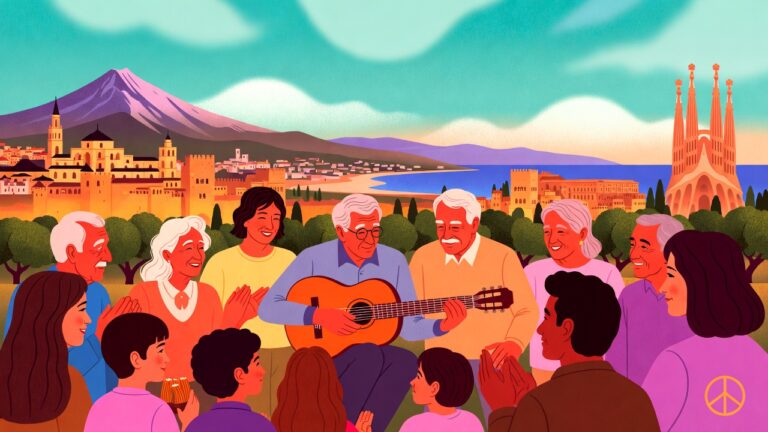
The first sound you hear as morning arrives over Madrid is the soft, warm note of a guitar striking a single string in a nearby café, mingled with the distant tolling of church bells and the scent of fresh churros and café con leche drifting from a churrería. That guitar-sound carries our story back to a time of sea and mountains, when we lived as the people of Spain. Our ancestors built the Mezquita of Córdoba with arches that seemed to hold the sky, the Alhambra in Granada with gardens full of water and light, the cathedrals of Santiago de Compostela where pilgrims came. Christians, Muslims, and Jews lived together for centuries in Al-Andalus, the Reconquista brought unity but also loss, explorers like Columbus and Magellan opened the world. Every family knew the feasts of Semana Santa where processions filled the streets, the flamenco that touched the soul, the bond stronger than differences. That was our golden time: a land of sea, mountains, and rivers, where people lived with history as guide and passion as compass, connected by art, faith, and adventure.
But then came the wave from outside, like a storm rising from the past. Roman rule, Moorish domination, Napoleonic invasions, the Civil War of 1936–1939 that cost millions and Franco's dictatorship until 1975. Every family knew the loss: a grandfather who fought on one side or the other, an uncle who vanished in prison, a child who learned freedom is fragile. The smell of smoke, the silence after bombs, the emptiness in the streets of Guernica and Madrid.
From that depth rises a pride that is hot and expressive. The guitar that still plays flamenco, the paella prepared with love, the Sagrada Família still growing. Our people laughing through pain, our youth rising for a better land, our bond stronger than history. We have found our voice again: democracy after Franco, EU accession in 1986, hope growing in the cities.
Yet the truth colors magenta like a sunset over the Sierra Nevada. The scars remain: memory of the Civil War and Franco, tensions between regions, emigration of youth, pressure of a fast-changing world. The outside world buys our tourism and our wine, but often does not feel the depth of a people who never broke.
Still, we remember in silence: on the squares where flamenco sounds, during Fiesta Nacional on 12 October when we raise our flag, in the mountains where the spirits still speak – never forgetting who we were. We tell our children of El Cid and of the Transición, of the sea and the mountains, so they know: we were connected and strong before we were challenged.
And yet… the guitar continues, soft and deep, like a promise drifting over the squares. That is our secret: we have suffered under domination, civil war, and dictatorship, but first we were a land of sea and passion. For our children we build no walls, but a plaza where everyone may dance. How do we let that string-sound bring hope to everyone again? How does Spain remain a home of rhythm and light?
January 2026
Manna Ori
A Través de los Ojos del Español
El primer sonido que escuchas cuando la mañana llega sobre Madrid es la nota suave y cálida de una guitarra que toca una sola cuerda en un café cercano, mezclada con el lejano repique de campanas de iglesia y el aroma de churros frescos y café con leche que sale de una churrería. Ese sonido de guitarra lleva nuestra historia de vuelta a un tiempo de mar y montañas, cuando vivíamos como el pueblo de España. Nuestros ancestros construyeron la Mezquita de Córdoba con arcos que parecían sostener el cielo, la Alhambra en Granada con jardines llenos de agua y luz, las catedrales de Santiago de Compostela donde llegaban peregrinos. Cristianos, musulmanes y judíos vivieron juntos durante siglos en Al-Ándalus, la Reconquista trajo unidad pero también pérdida, exploradores como Colón y Magallanes abrieron el mundo. Cada familia conocía las fiestas de Semana Santa donde las procesiones llenaban las calles, el flamenco que tocaba el alma, el lazo más fuerte que las diferencias. Ese fue nuestro tiempo dorado: una tierra de mar, montañas y ríos, donde la gente vivía con la historia como guía y la pasión como brújula, conectada por arte, fe y aventura.
Pero entonces llegó la ola de afuera, como una tormenta que surgió del pasado. Dominación romana, mora, invasiones napoleónicas, la Guerra Civil de 1936–1939 que costó millones y la dictadura de Franco hasta 1975. Cada familia conoció la pérdida: un abuelo que luchó en un bando o en otro, un tío que desapareció en prisión, un niño que aprendió que la libertad es frágil. El olor a humo, el silencio después de bombas, el vacío en las calles de Guernica y Madrid.
De esa profundidad surge un orgullo caliente y expresivo. La guitarra que aún toca flamenco, la paella preparada con amor, la Sagrada Família que aún crece. Nuestra gente que ríe a través del dolor, nuestra juventud que se levanta por una tierra mejor, nuestro lazo más fuerte que la historia. Hemos recuperado nuestra voz: la democracia después de Franco, la entrada en la UE en 1986, la esperanza que crece en las ciudades.
Sin embargo, la verdad se tiñe de magenta como un atardecer sobre la Sierra Nevada. Las cicatrices permanecen: el recuerdo de la Guerra Civil y Franco, las tensiones entre regiones, la emigración de jóvenes, la presión de un mundo que cambia rápido. El mundo exterior compra nuestro turismo y nuestro vino, pero a menudo no siente la profundidad de un pueblo que nunca se rompió.
Aun así, recordamos en silencio: en las plazas donde suena el flamenco, durante la Fiesta Nacional el 12 de octubre cuando izamos nuestra bandera, en las montañas donde los espíritus aún hablan – nunca olvidamos quiénes fuimos. Contamos a nuestros hijos de El Cid y de la Transición, del mar y de las montañas, para que sepan: estábamos conectados y fuertes antes de ser desafiados.
Y sin embargo… la guitarra continúa, suave y profunda, como una promesa que flota sobre las plazas. Ese es nuestro secreto: hemos sufrido bajo dominación, guerra civil y dictadura, pero primero fuimos una tierra de mar y pasión. Para nuestros hijos no construimos muros, sino una plaza donde todos puedan bailar. ¿Cómo hacemos para que ese sonido de cuerda vuelva a traer esperanza a todos? ¿Cómo España sigue siendo un hogar de ritmo y luz?
Enero 2026
Manna Ori