
Through the Eyes of the Tanzanian
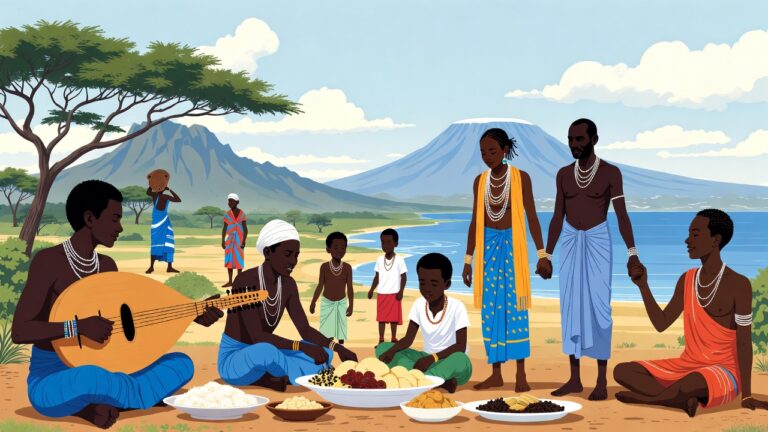
The first sound you hear as morning arrives over Zanzibar is the soft, waving note of a taarab ud playing a single tone, mingled with the distant call of a muezzin and the scent of fresh pilau (spiced rice with meat) and cloves drifting from a nearby home. That ud-sound carries our story back to a time of sea and savanna, when we lived as the peoples of Tanzania: the Swahili along the coast, the Maasai and Chagga in the highlands, the Sukuma, Nyamwezi, Haya, and many others inland. Our ancestors built cities like Kilwa and Zanzibar with mosques and palaces of coral stone, sailed dhows to Arabia, India, and China, grew cloves and coconut in fertile soil. The Maasai knew their moran warriors and knowledge of nature, the Chagga their sacred Mount Kilimanjaro, the Swahili their poetry and language that connected the world. Every family knew the feasts of Mwaka Kogwa where water was poured for cleansing, the tales of the ancestors, the bond stronger than differences. That was our golden time: a land of savanna, mountains, and sea, where people lived in harmony with Kilimanjaro as father and the Indian Ocean as mother, connected by trade, rhythm, and hospitality.
But then came the wave from outside, like a storm rising from the sea. The Portuguese, Omani, and Germans colonized us in the 19th century, the British took Tanganyika and Zanzibar, turned us into a source of ivory, cloves, and labor. Every family knew the loss: an ancestor who worked on plantations, a child who learned freedom was forbidden, a culture that had to adapt. Independence in 1961 (Tanganyika) and 1963 (Zanzibar), the union in 1964 with Julius Nyerere – hope that bloomed in ujamaa (family-socialism) – but also the challenges: economic crisis, emigration of youth, pressure of climate change on our coast and agriculture.
From that depth rises a pride that is warm and welcoming. The taarab that still fills the night, the pilau shared with love, the Kilimanjaro that protects us. Our people laughing through hardship, our youth rising for a better land, our bond stronger than history. We have found our voice again: democracy growing, hope burning along the coast.
Yet the truth colors magenta like a sunset over Zanzibar. The scars remain: memory of slavery and colonization, poverty in the villages, emigration of youth, pressure of climate change on our islands. The outside world buys our tourism and our cloves, but often does not feel the depth of a people who never broke.
Still, we remember in silence: around the taarab where music is made, during Union Day on 26 April when we raise our flag, in the villages where the spirits still speak – never forgetting who we were. We tell our children of the old kingdoms and of Nyerere, of the sea and the savanna, so they know: we were connected and strong before we were challenged.
And yet… the taarab continues, soft and waving, like a promise drifting over the islands. That is our secret: we have suffered under colonization, unrest, and change, but first we were a land of sea and rhythm. For our children we build no walls, but a square where everyone may dance. How do we let that drum-sound bring hope to everyone again? How does Tanzania remain a home of unity and laughter?
January 2026
Manna Ori
Kupitia Macho ya Mtanzania
Sauti ya kwanza unayosikia wakati asubuhi inafika juu ya Zanzibar ni sauti laini na yenye mdundo wa taarab inayocheza noti moja kwenye ud, ikichanganyika na sauti ya mbali ya muezzin na harufu ya pilau safi (wali wa viungo na nyama) na karafuu inayotoka nyumbani karibu. Sauti hiyo ya ud inabeba hadithi yetu nyuma katika wakati wa hekalu na bahari, wakati tulipoishi kama watu wa Tanzania: Waswahili kwenye pwani, Wamaasai na Wachagga kwenye nyanda za juu, Wasukuma, Wanyamwezi, Wahaya na wengine wengi bara. Mababu zetu walijenga miji kama Kilwa na Zanzibar na misikiti na majumba ya mawe ya matumbawe, walisafiri kwa dau kwenda Arabia, India na China, walipanda karafuu na nazi kwenye udongo wenye rutuba. Wamaasai walijua wapiganaji wao wa moran na maarifa yao ya asili, Wachagga mlima wao mtakatifu Kilimanjaro, Waswahili ushairi wao na lugha yao iliyounganisha dunia. Kila familia ilijua sherehe za Mwaka Kogwa ambapo maji yalimwagwa kwa utakaso, hadithi za mababu, umoja uliokuwa mkali kuliko tofauti. Hiyo ilikuwa wakati wetu wa dhahabu: nchi ya nyanda za juu, misitu na bahari, ambapo watu waliishi kwa amani na Kilimanjaro kama baba na Bahari ya Hindi kama mama, wakiunganishwa na biashara, mdundo na ukarimu.
Lakini basi wimbi kutoka nje likaja, kama dhoruba iliyotoka baharini. Wareno walifika 1505, Waholanzi na Waingereza walifuata, walitutawala kwa karne tatu, wakagawanya ardhi yetu kwa ajili ya chai, mpira wa miguu na mdalasini. Kila familia ilijua hasara: babu aliyefanya kazi kwenye mashamba, mtoto aliyejifunza uhuru ulikatazwa, utamaduni uliolazimika kubadilika. Uhuru mwaka 1948 (Tanganyika) na 1963 (Zanzibar), muungano mwaka 1964 na Julius Nyerere – matumaini yaliyochanua katika ujamaa (ujamaa wa familia) – lakini pia changamoto za taifa jipya: mgogoro wa kiuchumi, uhamiaji wa vijana, shinikizo la mabadiliko ya hali ya hewa kwenye pwani na kilimo chetu.
Kutoka kwa kina hicho kunatoka fahari yenye joto na kustahimili. Taarab inayojaza usiku, pilau inayotayarishwa kwa upendo, Kilimanjaro inayotulinda. Watu wetu wanasikitika kupitia shida, vijana wetu wanasimama kwa nchi bora, umoja wetu mkali kuliko maumivu. Tumepata tena sauti yetu: amani baada ya 2009, matumaini yanayokua kando ya pwani.
Lakini ukweli unapaka magenta kama machweo juu ya Sigiriya. Makovu yanabaki: kumbukumbu ya vita vya wenyewe kwa wenyewe, umasikini katika vijiji, uhamiaji wa vijana, shinikizo la mabadiliko ya hali ya hewa kwenye pwani zetu. Ulimwengu wa nje unanunua chai yetu na utalii wetu, lakini mara nyingi hauhisi kina cha watu ambao hawajavunjika kamwe.
Hata hivyo, tunakumbuka kwa kimya: karibu na geta bera ambapo muziki unatengenezwa, wakati wa Siku ya Uhuru tarehe 4 Februari tunapoinua bendera yetu, katika mahekalu ambapo roho bado zinazungumza – hatutawahi kusahau tulikuwa nani. Tunawaambia watoto wetu kuhusu falme za kale na Senanayake, bahari na milima, ili wajue: tulikuwa tumeunganishwa na wenye nguvu kabla ya kupingwa.
Na bado… geta bera inaendelea, ya kina na ya chini, kama mapigo ya moyo yasiyokoma. Hiyo ndiyo siri yetu: tumeteseka chini ya ukoloni, vita vya wenyewe kwa wenyewe na machafuko, lakini kwanza tulikuwa nchi ya mahekalu na bahari. Kwa watoto wetu hatujengi kuta, bali uwanja wa hekalu ambapo kila mtu anaweza kuomba. Je, tunafanyaje ili sauti hiyo ya ngoma ilete tumaini kwa kila mtu tena? Je, Sri Lanka inabaki kuwa nyumba ya mdundo na umoja?
Januari 2026
Manna Ori