
Through the Eyes of the Uzbek
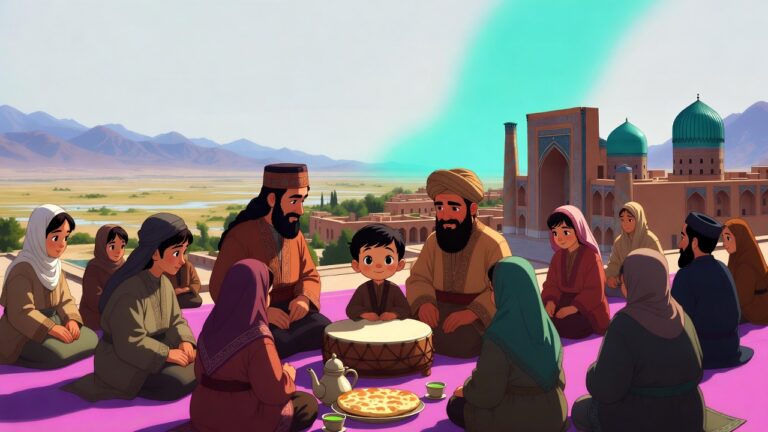
The first sound you hear as morning arrives over Samarkand is the soft, rolling beat of a doira (frame drum) striking once, blended with the distant call of a muezzin from the Registan mosque and the aroma of fresh non (flatbread) and green tea drifting from a nearby chaikhana. That drum sound carries our story back to a time of the Silk Road and blue domes, when we lived as the people of Uzbekistan. Our ancestors built the Registan with its madrasas that gathered knowledge, the Gur-e Amir with its turquoise dome where Tamerlane rests, cities like Bukhara and Khiva where caravans stopped. The Timurids brought art and science, traders carried silk, spices, and paper along the route to China and Europe. Every family knew the feasts of Navruz where fires were jumped and tables overflowed with plov, the stories of Alisher Navoi who exalted the language, the bond stronger than the desert. That was our golden time: a land of oases, mountains, and desert, where people lived in harmony with the Silk Road as mother and the Pamir as father, connected through poetry, trade, and hospitality.
But then came the wave from outside, rising like a storm from the north. The Russians annexed us in the 19th century, the Soviets in 1924 made us a republic with borders that divided tribes, collectivisation and repression brought famine and deportations. Every family knew the loss: a grandfather who vanished in the hunger, a child forced to speak Russian at school, a culture held in secret. Independence in 1991 brought Islam Karimov—hope that began but turned into authoritarian control—and later Shavkat Mirziyoyev who slowly brought reforms. Every family knew the fear, the silence, the emptiness in the villages.
From that depth rises a pride that is deep and welcoming. The doira still beats in the villages, plov prepared with love, the blue domes still shining. Our people laugh through hardships, our young dream of a better country, our bonds stronger than the desert. We have reclaimed our voice: the reforms, the hope growing in the oases.
Yet the truth colours magenta like a sunset over the Registan. The scars remain: the memory of Soviet times, the authoritarian years, the emigration of youth, the pressure of a fast-changing world. The outside world buys our cotton and our tourism, but often fails to feel the depth of a people that never broke.
Still, we remember in silence: around the doira where music is born, on Independence Day the 1st of September when we raise our flag, in the madrasas where spirits still speak—never forgetting who we were. We tell our children of Timur and of Navoi, of the Silk Road and the mountains, so they know: we were connected and strong before the challenges came.
And yet… the doira continues, deep and low, like a heartbeat that never falls silent. That is our secret: we have suffered under colonisation, repression, and change, but first we were a land of the Silk Road and poetry. For our children we build no walls, but a caravan square where everyone may gather. How do we let that drum sound bring hope once more to all? How does Uzbekistan remain a home of hospitality and wisdom?
January 2026
Manna Ori
O'zbekning Ko'zidan
Samarqand ustiga tong otganda birinchi eshitiladigan tovush — doira (ramka do'mbirasi) bir marta urilishi, yumshoq, to'lqinli ovoz, Registon masjididan uzoqdan muazzin chaqirig'i bilan aralashib, yaqin choyxonadan yangi non (tekis non) va yashil choy hidi taralib turadi. Bu doira ovozi bizni Ipak yo'li va moviy gumbazlar zamoniga qaytaradi, biz O'zbekiston deb ataydigan yurtimizda o'zbek bo'lib yashagan paytimizga. Ajdodlarimiz bilim to'plagan madrasalari bilan Registonni qurdilar, Temur Amir dam olgan turkuaz gumbazli Gur-e Amirni, karvonlar to'xtagan Buxoro va Xivani. Temuriylar san'at va ilm keltirdilar, savdogarlar Xitoy va Yevropaga ipak, ziravor va qog'oz olib bordilar. Har bir oila Navro'z bayramlarini bilardi, olovdan sakrash va plov bilan to'la dasturxonlar, Alisher Navoi tilni ulug'lagan hikoyalar, cho'lga qaraganda kuchliroq bog'lanish. Bu bizning oltin davrimiz edi: vohalar, tog'lar va cho'l yurt; Ipak yo'li ona, Pomir ota sifatida uyg'unlikda yashagan, she'riyat, savdo va mehmondo'stlik bilan bog'langan.
Lekin tashqaridan to'lqin keldi, shimoldan bo'rondek ko'tarildi. Ruslar XIX asrda bizni qo'shib oldilar, sovetlar 1924 yilda qabilalarni bo'lgan chegarali respublika qildilar, kollektivlashtirish va bosim ocharchilik va surgun keltirdi. Har bir oila yo'qotishni bildi: ochlikda yo'qolgan bobo, maktabda ruscha gapirishga majbur bo'lgan bola, yashirin saqlangan madaniyat. 1991 yildagi mustaqillik Islom Karimovni olib keldi — boshlangan umid avtoritar nazoratga aylandi — keyin Shavkat Mirziyoyev asta-sekin islohotlar olib keldi. Har bir oila qo'rquvni, sukutni, qishloqlardagi bo'shliqni bildi.
Bu chuqurlikdan chuqur va mehmondo'st g'urur ko'tariladi. Doira hali ham qishloqlarda uriladi, plov sevgi bilan pishiriladi, moviy gumbazlar hali ham yaltiraydi. Bizning odamlar qiyinchiliklarga kulib o'tadi, yoshlar yaxshiroq yurtni orzu qiladi, bog'lanishimiz cho'ldan kuchliroq. Ovozimizni qaytarib oldik: islohotlar, vohalarda o'sayotgan umid.
Lekin haqiqat Registon ustidagi quyosh botishi kabi magenta rangda. Yaralar qoladi: sovet davri xotirasi, avtoritar yillar, yoshlarning ko'chishi, tez o'zgarayotgan dunyoning bosimi. Tashqi dunyo bizning paxtamiz va turizmimizni sotib oladi, lekin hech qachon sinmagan xalqning chuqurligini sezmaydi ko'pincha.
Shunga qaramay sukutda eslaymiz: doira atrofida musiqa tug'ilgan joyda, 1 sentyabr Mustaqillik kunida bayrog'imizni ko'targanimizda, madrasalarda ruhlar hali gapirayotgan joyda — kim bo'lganimizni hech qachon unutmaymiz. Bolalarimizga Temur va Navoiyni, Ipak yo'li va tog'larni aytamiz, bilsinlar: qiyinchiliklar kelmasdan oldin bog'langan va kuchli edik.
Va shunga qaramay… doira davom etadi, chuqur va past, hech qachon jim bo'lmaydigan yurak urishi kabi. Bu bizning sirimiz: kolonizatsiya, bosim va o'zgarish ostida azob chekdik, lekin avvalo Ipak yo'li va she'riyat yurti edik. Bolalarimiz uchun devor emas, hamma yig'iladigan karvon maydonini quramiz. Qanday qilib bu doira ovozini yana hammaga umid keltiramiz? O'zbekiston mehmondo'stlik va donolik uyi bo'lib qanday qoladi?
Yanvar 2026
Manna Ori