
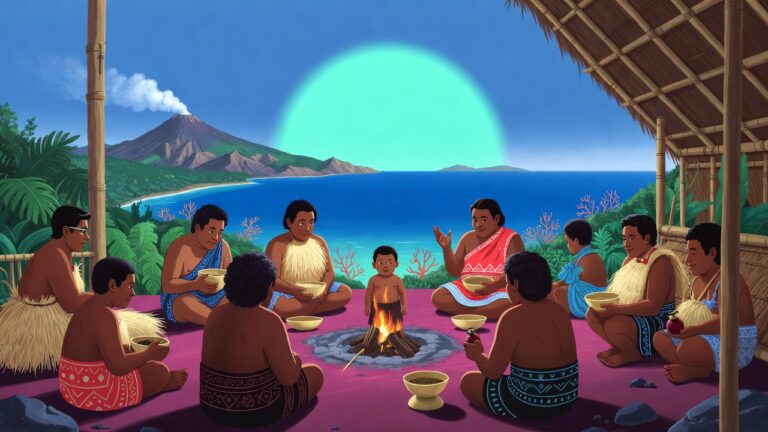
Through the Eyes of the Vanuatuan
The first thing you feel as morning comes over Port Vila is the soft, endless sound of waves breaking against the coral reef, blended with the distant call of a tropical bird and the scent of fresh laplap (cassava pudding with coconut) and smoked fish drifting from a nearby home. That wave murmur carries our story back to a time of islands and infinite horizons, when we lived as the peoples of Vanuatu: the Ni-Vanuatu of more than 80 languages and cultures across 83 islands. Our ancestors built nakamals (community houses) where stories were shared, fished with canoes in the deep blue sea, grew yam and kava in fertile volcanic soil. They lived in harmony with the sea as mother and the volcanoes as father: chiefs who ruled with respect, tamtam dances and water music that filled the night with rhythm, communities where kastom (traditional law) was the law and sharing was natural. Every family knew the legends of the first people who came from the sea, the grade-taking ceremonies where status was earned, the bond stronger than the distance between islands. That was our golden time: a land of volcanoes, reefs, and jungle, where people lived with the ocean as road and the stars as guide—free and connected through kastom and rhythm.
But then came the wave from outside, rising like a storm from the Pacific. The British and French colonized us in the 19th century as the New Hebrides, dividing the islands in condominium, trying to break us with taxes and forced labour. Every family knew the loss: an ancestor who worked on plantations, a child taught that freedom was forbidden, a culture held in secret. Independence in 1980 brought Walter Lini—hope that grew—but also the trials of a young island nation: the attempted coup in 1980, tensions between anglophone and francophone, the emigration of youth to Australia and New Zealand, the pressure of climate change threatening our atolls and swallowing our coasts.
From that depth rises a pride that is warm and resilient. The kastom dances still fill the night, laplap prepared with love, kava drunk in ceremonies. Our people laugh through hardships, our young dream of a future on the islands, our bonds stronger than the sea. We have reclaimed our voice: independence, calls to the world for climate action, the hope that never drowns.
Yet the truth colours magenta like a sunset over Yasur volcano. The scars remain: the colonial division still in memory, the rising sea swallowing islands, poverty on remote atolls, the emigration of youth. The outside world buys our tourism and our kava, but often fails to feel the depth of a people literally fighting the waves.
Still, we remember in silence: around the nakamal where kava is shared, on Independence Day the 30th of July when we raise our flag, on the beaches where spirits still speak—never forgetting who we were. We tell our children of the ancient clans and of Lini, of the sea and the volcanoes, so they know: we were connected and strong before the challenges came.
And yet… the wave murmur continues, calm and endless, like a promise that the sea always returns. That is our secret: we have suffered under colonisation, division, and rising seas, but first we were a land of islands and rhythm. For our children we build no walls, but a nakamal where everyone is welcome. How do we let that drum sound bring hope once more to all? How does Vanuatu remain a home of connection and resilience?
January 2026
Manna Ori
Long We Ol Man Vanuatu I Luk
Fas samting yu fil long mornen i kam antap long Port Vila i sof, no gat en we i stop blong ol wev i brek long koral rif, miskis wetem longwe krae blong wan tropikal pad blong solwata mo smel blong fres laplap (kasava puding wetem kokonat) mo smok fis i kamaot long haos we i klosap. Dat wev saon i karem bak stori blong yumi go long taem blong ol aelan mo no gat en we i stop blong horizon, taem yumi stap laef olsem ol pipol blong Vanuatu: Ni-Vanuatu blong moren 80 langgus mo kalsa long 83 aelan. Ol tumbuna blong yumi i bin mekem ol nakamal (komuniti haos) we stori i bin pas long hem, i fis wetem kenu long dip blu si, i gro yam mo kava long gudfala volkenik graon. Oli stap long gudfala fasin wetem si olsem mama mo volkeno olsem papa: ol jif oli rul wetem rispek, ol tamtam dans mo wata myusik i fulumap naet wetem ritim, komuniti we kastom (tradișonal lo) i bin lo mo sapot i bin normal. Evri famili i save ol legend blong fas pipol we i kam long si, ol grade-taking seremoni we status i bin winim, bond i strong moa long distens blong ol aelan. Dat i bin golden taem blong yumi: wan kantri blong volkeno, rif mo jungle, we pipol i stap laef wetem osian olsem rod mo sta olsem gaed—fri mo konekted troo kastom mo ritim.
Be den i kam wev blong aotsaet, i kamaot olsem storm long Pasifik. Britis mo Frans i bin kolonisaem yumi long 19 senchuri olsem New Hebrides, i bin devedem aelan long condominium, i traem brekem yumi wetem taks mo fos wok. Evri famili i save loss: wan tumbuna we i wok long plantesen, wan pikinini we i lan se fri i bin no alaw, wan kalsa we i mas stap sekret. Indipendens long 1980 i bin bringim Walter Lini—hop we i gro—be tu ol trael blong yong aelan kantri: wan coup traem long 1980, tensen blong anglophone mo francophone, emigresen blong yut go long Ostrelia mo Nyu Zilant, presha blong klima chenj we i tretem ol atoll blong yumi mo swalowem kos blong yumi.
Long dat dip i kamaot wan praud we i wom mo strong. Kastom dans i stil fulumap naet, laplap i mekem wetem lav, kava i dring long seremoni. Ol pipol blong yumi i laf troo hadtaem, yut i drim long fyucha long aelan, bond blong yumi i strong moa long si. Yumi bin karem bak vois blong yumi: indipendens, kol blong wol long klima aksen, hop we i no drowning nevah.
Be tru i kolor magenta olsem san set long Yasur volkeno. Ol skas i stap: kolonial deved we i stap long memori, si we i kamaot antap we i swalowem aelan, poveti long rimot atoll, emigresen blong yut. Wol aotsaet i bay turism mo kava blong yumi, be kuazi nevah i filim dip blong wan pipol we i fitem wev long real laef.
Be yumi rememba long kwaet: raon long nakamal we kava i sapot, long Indipendens Dey 30 July wen yumi raesem flaeg blong yumi, long bis we ol spirit i stil toktok—yumi no fogetem hu yumi bin. Yumi talem long pikinini blong yumi blong ol old klan mo Lini, blong si mo volkeno, sapos oli save: yumi bin konekted mo strong bifor ol chalenj i kam.
Be yet… wev saon i kontinyu, kwaet mo no gat en, olsem promis se si i olwe i kamaot bak. Dat i sikret blong yumi: yumi bin sofre long koloniz, deved mo si we i kamaot antap, be fas yumi bin kantri blong aelan mo ritim. Long pikinini blong yumi yumi no mekem wol, be wan nakamal we evriwan i welkom. Olsem wanem yumi letem dat drum saon i karem bak hop long evriwan? Olsem wanem Vanuatu i stap haos blong koneksen mo strong?
Januari 2026
Manna Ori