
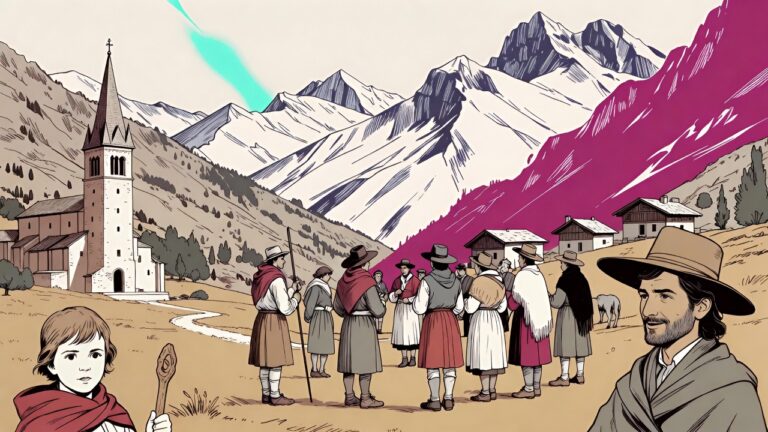
Through the Eyes of the Andorran
In the quiet heights of the Pyrenees, through centuries of snow, stone, and gentle freedom, lies a story woven from mountain winds, hearth smoke, and an unbreakable calm. This is the story of us, the Andorrans, told through the voices of those who bore the deepest silences, whose sacrifices have shaped the spirit of our small land.
Our suffering did not begin with a single invasion, but with the eternal shadow of larger neighbors who sought to swallow us. We, the Andorrans—shepherds, smugglers, mountain dwellers—lived in valleys where time moved slowly, with our Romanesque churches, our stone casas, and our language that breathes Catalan. We knew no kings of our own blood, but a unique co-principality: the Bishop of Urgell and the President of France as our protectors, a balance that kept us free from war for centuries.
But the pain came like a silent avalanche: we were never conquered, yet never fully left alone. In the Middle Ages we paid tribute to remain independent; in the 20th century we became a refuge for smugglers and refugees—a neutral islet in a sea of wars. The Spanish Civil War and World War II brought tension: refugees crossing the passes, Nazis and Allies brushing past without occupying us. After the war, our country turned into a tax haven, shops full of luxury for day-trippers from France and Spain—prosperity, but also the feeling that our land sometimes became more shopping center than home.
The pain that lingers is no passing snowstorm; it is a quiet question of who we truly are in a world that finds us small. Our youth often leave for Barcelona or Toulouse to study and work, our language and traditions risk diluting amid tourism and commerce. Our peace is disturbed by avalanches of visitors, our nature by ski slopes and roads. We have no army, no loud voice in the world, and sometimes we feel forgotten between giants.
Our land was worn down by seasons of tourists, our valleys filled with hotels, our silence sometimes drowned by engines and lifts.
But from this depth of suffering, from the shadow of larger neighbors and quiet changes, arose a pride as soft as fresh snow and strong as granite. We, the Andorrans, have always maintained balance, with a resilience rooted in our neutrality and our nature. We remained independent when others fell, offered shelter to those fleeing, preserved our Romanesque churches and borda houses. We live in a country where peace is not a word, but daily bread—no war in centuries, no army needed.
This pride is no loud cheer; it is the quiet strength of a people who say "visca Andorra" with a smile and a nod. It is the pride in our mountains that breathe, our lakes that mirror, our feasts with escaldums and contrapas. It is the pride in our multilingualism—Catalan, French, Spanish, Portuguese—and our hospitality that welcomes everyone. It is the pride in millions of nameless Andorrans who live in silence, work, respect nature, and preserve a small paradise.
The world often looks at our story without full understanding. They see us as duty-free shopping, as a ski resort, as a curiosity between France and Spain, but not as a people with our own heartbeat. They forget how we bought freedom with cleverness rather than weapons, how we preserved peace while Europe burned.
For us, every walk in the valleys, every hearth fire in winter, every festa major is a tribute to those who kept our land free. Our children grow up with stories of courage and balance, of shepherds and bishops, of grandparents who smuggled to survive, of parents who cherish calm. These stories are no fairy tales; they are the foundations of who we are. They teach us what it means to be Andorran—to be small yet not feel small, to be neutral without being invisible, to live in harmony with mountains and neighbors.
Our history is no closed book; it is a living mountain wind that shapes us. It has made us a people who have endured the unthinkable—remaining free without an army, prosperous without exploitation. This is what those without empathy cannot grasp: the depth of our sorrow is as great as the height of our pride. This duality of pain and calm will forever be etched in our hearts, a testament to our strength, a call to the world to hear our story, and a promise that we, the Andorrans, will continue to stand, no matter the storms that assail us.
#004-EN – Through the Eyes of the Andorran
7-2-2026. Manna.
Des dels Ulls de l'Andorrà
En les quietes altures dels Pirineus, a través de segles de neu, pedra i una dolça llibertat, hi ha una història teixida amb vents de muntanya, fum de llar i una calma inquebrantable. Aquesta és la història nostra, dels andorrans, explicada a través de les veus d’aquells qui van suportar els silencis més profunds, els sacrificis dels quals han format l’ànima del nostre petit país.
El nostre patiment no va començar amb una sola invasió, sinó amb l’ombra eterna de veïns més grans que volien engolir-nos. Nosaltres, els andorrans – pastors, contrabandistes, habitants de muntanya – vivíem en valls on el temps anava lent, amb les nostres esglésies romàniques, les nostres cases de pedra i la nostra llengua que respira català. No coneixíem reis de la nostra pròpia sang, sinó un singular coprincipat: el bisbe d’Urgell i el president de França com a protectors, un equilibri que ens va mantenir lliures de guerra durant segles.
Però el dolor va arribar com una allau silenciosa: mai vam ser conquerits, però tampoc mai completament deixats sols. A l’Edat Mitjana pagàvem tribut per romandre independents; al segle XX vam esdevenir un refugi per contrabandistes i refugiats – una illa neutral en un mar de guerres. La Guerra Civil Espanyola i la Segona Guerra Mundial van portar tensió: refugiats creuant els passos, nazis i aliats fregant-nos sense ocupar-nos. Després de la guerra, el nostre país es va convertir en un paradís fiscal, botigues plenes de luxe per a visitants d’un dia de França i Espanya – prosperitat, però també la sensació que la nostra terra esdevenia a vegades més centre comercial que llar.
El dolor que perdura no és una tempesta de neu passatgera; és una pregunta silenciosa sobre qui som realment en un món que ens troba petits. Els nostres joves sovint marxen a Barcelona o Tolosa per estudiar i treballar, la nostra llengua i tradicions corren risc de diluir-se entre turisme i comerç. La nostra pau és pertorbada per allaus de visitants, la nostra natura per pistes d’esquí i carreteres. No tenim exèrcit, ni veu forta al món, i a vegades ens sentim oblidats entre gegants.
La nostra terra es va desgastar per estacions de turistes, les nostres valls plenes d’hotels, el nostre silenci a vegades ofegat per motors i remuntadors.
Però d’aquesta profunditat de patiment, de l’ombra de veïns més grans i canvis silenciosos, va sorgir un orgull tan suau com neu fresca i fort com granit. Nosaltres, els andorrans, sempre hem mantingut l’equilibri, amb una resiliència arrelada en la nostra neutralitat i la nostra natura. Vam romandre independents quan altres van caure, vam oferir refugi a qui fugia, vam preservar les nostres esglésies romàniques i cases borda. Vivim en un país on la pau no és una paraula, sinó pa quotidià – cap guerra en segles, cap exèrcit necessari.
Aquest orgull no és una cridòria forta; és la força silenciosa d’un poble que diu “visca Andorra” amb un somriure i un assentiment. És l’orgull de les nostres muntanyes que respiren, dels nostres llacs que reflecteixen, de les nostres festes amb escaldums i contrapas. És l’orgull de la nostra multilingüitat – català, francès, espanyol, portuguès – i la nostra hospitalitat que acull tothom. És l’orgull de milions d’andorrans sense nom que viuen en silenci, treballen, respecten la natura i preserven un petit paradís.
El món sovint mira la nostra història sense comprensió completa. Ens veuen com compres lliures d’impostos, com estació d’esquí, com curiositat entre França i Espanya, però no com un poble amb el seu propi batec. Obliden com vam comprar llibertat amb astúcia en lloc d’armes, com vam preservar pau mentre Europa cremava.
Per a nosaltres, cada passeig per les valls, cada foc de llar a l’hivern, cada festa major és un homenatge a qui van mantenir la nostra terra lliure. Els nostres fills creixen amb històries de coratge i equilibri, de pastors i bisbes, d’avis que contrabandejaven per sobreviure, de pares que estimen la calma. Aquestes històries no són contes; són els fonaments del que som. Ens ensenyen què significa ser andorrà – ser petit però no sentir-se petit, ser neutral sense ser invisible, viure en harmonia amb muntanyes i veïns.
La nostra història no és un llibre tancat; és un vent de muntanya viu que ens forma. Ens ha fet un poble que ha suportat l’impensable – romandre lliures sense exèrcit, pròspers sense explotació. Això és el que aquells sense empatia no poden comprendre: la profunditat del nostre dolor és tan gran com l’alçada del nostre orgull. Aquesta dualitat de dolor i calma quedarà per sempre gravada en els nostres cors, un testimoni de la nostra força, una crida al món per escoltar la nostra història, i una promesa que nosaltres, els andorrans, continuarem dempeus, sigui quina sigui la tempesta que ens assalti.
#004-CA – Des dels Ulls de l'Andorrà
7-2-2026. Manna.