
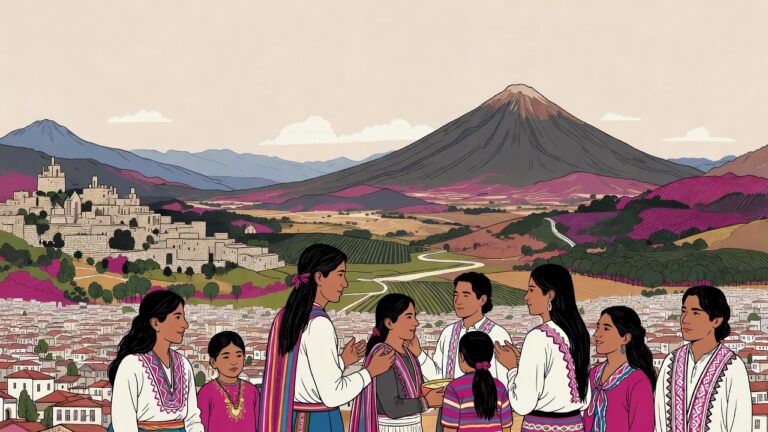
Through the Eyes of the Salvadoran
A drum beats deep and low through a barrio in San Salvador, the rhythm mingled with the distant sizzle of pupusas on the comal and the scent of curtido drifting through the air. That drumming carries our story back to a time of fire and freedom, when we lived as the Pipil and Lenca on this small land we called Cuzcatlán, "place of jewels". Our ancestors built cities of stone and adobe, grew maize and cacao in the fertile volcanic soil, wove colorful huipiles and honored the gods with dances and offerings. The Pipil knew their hero Atlacatl who fought the Spanish conquerors, the Lenca their sacred mountains and knowledge of herbs. Every family knew the creation stories, the feasts where everyone danced around the fire, the communities where sharing was normal and respect for elders was the law. That was our golden time: a small land of volcanoes and coffee, where people lived with the earth as mother and the mountains as father, connected by rhythm and courage.
But then came the wave from outside, like a hurricane rising from the mountains. The Spaniards arrived in 1524, and within years Cuzcatlán had fallen. They took our land, our people as slaves, our temples as pagan. Every family knew the loss: an ancestor who disappeared in the mines, a language that had to survive in secret, a culture that mixed to endure. Independence in 1821 brought hope, but also centuries of dictatorships and inequality. The civil war from 1980 to 1992 was hell: more than 75,000 dead, villages burned to the ground, families fleeing, the FMLN and the army tearing each other apart while the outside world supplied weapons. Every family knew someone who disappeared, a house that burned, a child who grew up in exile.
From that depth comes a pride that is hot and resilient. The pupusas we share around the table, the cumbia and cumbia rebajada that fills the streets, the mountain coffee that wakes the world. Our people who laugh through tears, our women who lead markets with strength, our young people who rise for a better country. We have found our voice again: the peace accords of 1992, the democracy that slowly grows, the artists who reach the world.
Yet the truth colors magenta like a sunset over the Izalco volcano. The scars remain: the poverty in the barrios, the gangs that swallow young people, the emigration to the north, the corruption that sometimes returns. The outside world buys our coffee and our people as labor, but often does not see the pain of the war, not the struggle for justice.
Still, we remember in silence: on the markets where pupusas are made, during Independence Day on September 15 when we raise our flag, in the barrios where the drum still beats – never forgetting who we were. We tell our children of the Pipil and of Romero, of the volcanoes and the sea, so they know: we were connected and courageous before we were challenged.
And yet… the drum keeps going, low and deep, like a heartbeat that never falls silent. That is our secret: we have suffered under colonization, wars, and violence, but first we were a land of rhythm and fire. For our children we build no walls, but a comal where everyone can share. How do we let that rhythm bring hope again for everyone, how does El Salvador remain a home of courage and laughter?
January 2026
Manna Ori
A través de los ojos del salvadoreño
Un tambor late profundo y bajo por un barrio de San Salvador, el ritmo mezclado con el siseo lejano de las pupusas en el comal y el aroma de curtido que flota en el aire. Ese redoble lleva nuestra historia de vuelta a un tiempo de fuego y libertad, cuando vivíamos como pipiles y lencas en esta pequeña tierra que llamábamos Cuzcatlán, “lugar de joyas”. Nuestros ancestros construyeron ciudades de piedra y adobe, cultivaron maíz y cacao en la tierra volcánica fértil, tejieron huipiles coloridos y honraron a los dioses con danzas y ofrendas. Los pipiles conocían a su héroe Atlacatl que luchó contra los conquistadores españoles, los lencas sus montañas sagradas y su conocimiento de hierbas. Cada familia conocía las historias de la creación, las fiestas donde todos bailaban alrededor del fuego, las comunidades donde compartir era lo normal y el respeto a los mayores era la ley. Esa fue nuestra época dorada: una tierra pequeña de volcanes y café, donde la gente vivía con la tierra como madre y las montañas como padre, conectados por ritmo y coraje.
Pero entonces llegó la ola de afuera, como un huracán que se levantó de las montañas. Los españoles llegaron en 1524, y en pocos años Cuzcatlán cayó. Se llevaron nuestra tierra, a nuestra gente como esclavos, nuestros templos como paganos. Cada familia conocía la pérdida: un ancestro que desapareció en las minas, una lengua que tuvo que sobrevivir en secreto, una cultura que se mezcló para perdurar. La independencia en 1821 trajo esperanza, pero también siglos de dictaduras y desigualdad. La guerra civil de 1980 a 1992 fue un infierno: más de 75.000 muertos, pueblos quemados, familias huyendo, la FMLN y el ejército destrozándose mientras el mundo exterior suministraba armas. Cada familia conocía a alguien que desapareció, una casa que ardía, un niño que creció en el exilio.
De esa profundidad nace un orgullo caliente y resiliente. Las pupusas que compartimos alrededor de la mesa, la cumbia y la cumbia rebajada que llena las calles, el café de las montañas que despierta al mundo. Nuestra gente que ríe entre lágrimas, nuestras mujeres que lideran mercados con fuerza, nuestros jóvenes que se levantan por un país mejor. Hemos recuperado nuestra voz: los acuerdos de paz de 1992, la democracia que crece poco a poco, los artistas que llegan al mundo.
Sin embargo, la verdad se tiñe de magenta como un atardecer sobre el volcán Izalco. Las cicatrices quedan: la pobreza en los barrios, las pandillas que se tragan a los jóvenes, la emigración al norte, la corrupción que a veces regresa. El mundo exterior compra nuestro café y nuestra gente como mano de obra, pero muchas veces no ve el dolor de la guerra, no la lucha por justicia.
Aun así, recordamos en silencio: en los mercados donde se hacen pupusas, durante el Día de la Independencia el 15 de septiembre cuando izamos nuestra bandera, en los barrios donde el tambor aún late – nunca olvidando quiénes fuimos. Les contamos a nuestros hijos de los pipiles y de Romero, de los volcanes y el mar, para que sepan: fuimos unidos y valientes antes de ser desafiados.
Y sin embargo… el tambor sigue, bajo y profundo, como un latido que nunca calla. Ese es nuestro secreto: hemos sufrido bajo colonización, guerras y violencia, pero primero fuimos una tierra de ritmo y fuego. Para nuestros hijos no construimos muros, sino un comal donde todos puedan compartir. ¿Cómo dejamos que ese ritmo vuelva a traer esperanza para todos, cómo sigue siendo El Salvador un hogar de coraje y risa?
Enero 2026
Manna Ori