
Through the Eyes of the Equatorial Guinean
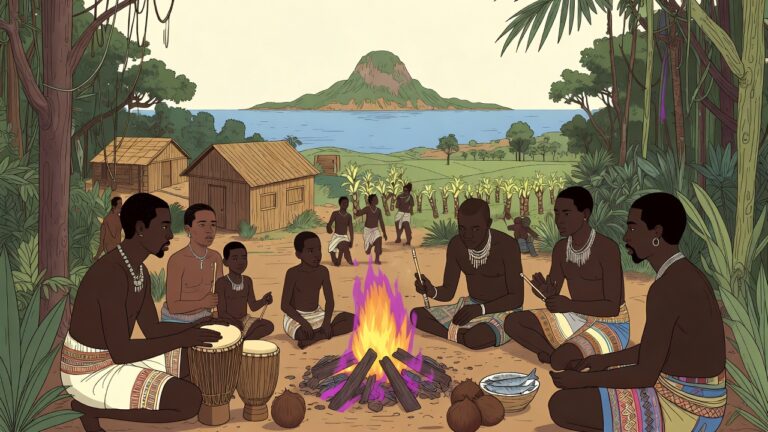
The first thing you hear as morning comes over Bioko is the deep, rolling sound of a drum rising from a village in the jungle, mingled with the distant calls of monkeys and the scent of coconut oil and smoked fish drifting from an open fire. That drumming carries our story back to a time of forests and sea, when we lived as the Bubi on Bioko and the Fang, Ndowe, and other peoples on the mainland. Our ancestors built villages of wood and palm, grew cassava and bananas in the fertile soil, fished with canoes in the Gulf of Guinea. The Bubi knew their sacred mountains and kings who spoke with the spirits, the Fang their reliquaries and knowledge of the forest, the Ndowe their trade across the sea. Every family knew the creation stories, the initiation rites in the forest, the communities where sharing was normal and respect for ancestors was the law. That was our golden time: a land of two worlds – Bioko as a green pearl and the mainland as the heart of the jungle – where people lived in harmony with the sea as brother and the forest as mother.
But then came the wave from outside, like a storm rising from the ocean. The Portuguese arrived in the 15th century, followed by the Spaniards who claimed us in 1778. They called us Spanish Guinea and turned us into a plantation colony: cocoa and coffee for their wealth, while we worked under the whip. Every family knew the loss: an ancestor who disappeared on the plantations, a language that had to survive in secret, a culture that was smothered. Independence in 1968 brought Francisco Macías Nguema – a dictator who plunged the country into terror, murdered tens of thousands, closed schools, and exterminated intellectuals. After his fall in 1979 came Teodoro Obiang, and the oil discovered in the 1990s made a few rich but many poorer. Every family knew the fear, the disappearances, the silence in the streets of Malabo.
From that depth comes a pride that is deep and silent. The drums that still beat in the villages, the dances of the Bubi and Fang that fill the night, the cocoa that still grows on Bioko. Our people who survive in the jungle and on the island, our resilience that says: "We are still here." We are a small country with a great soul – a mix of Bantu, Spanish, and African bloodlines that never fully broke.
Yet the truth colors magenta like a sunset over the Gulf of Guinea. The scars remain: the dictatorship that continues, the oil that brings wealth but also division, the poverty in the villages, the young people who emigrate because the future sometimes feels far away. The outside world buys our oil and cocoa, but often does not see the pain of terror, not the struggle for freedom.
Still, we remember in silence: around the fire where stories are passed on, during Independence Day on October 12 when we raise our flag, in the forests where the spirits still speak – never forgetting who we were. We tell our children of the old kings and the drums, of the sea and the jungle, so they know: we were connected and strong before we were challenged.
And yet… the drum keeps going, deep and low, like a heartbeat that never falls silent. That is our secret: we have suffered under colonization, dictatorship, and division, but first we were a land of forests and sea. For our children we build no walls, but a drum circle where everyone may join the beat. How do we let that rhythm bring hope again for everyone, how does Equatorial Guinea remain a home of strength and silence?
January 2026
Manna Ori
A través de los ojos del ecuatoguineano
Lo primero que oyes cuando la mañana llega a Bioko es el sonido profundo y rodante de un tambor que se eleva desde un pueblo en la selva, mezclado con los lejanos gritos de monos y el aroma de aceite de coco y pescado ahumado que sale de un fuego abierto. Ese redoble lleva nuestra historia de vuelta a un tiempo de bosques y mar, cuando vivíamos como los bubi en Bioko y los fang, ndowe y otros pueblos en el continente. Nuestros ancestros construyeron aldeas de madera y palma, cultivaron mandioca y plátanos en la tierra fértil, pescaron con canoas en el Golfo de Guinea. Los bubi conocían sus montañas sagradas y sus reyes que hablaban con los espíritus, los fang sus reliquias y su conocimiento del bosque, los ndowe su comercio por mar. Cada familia conocía las historias de la creación, los ritos de iniciación en la selva, las comunidades donde compartir era lo normal y el respeto a los ancestros era la ley. Esa fue nuestra época dorada: una tierra de dos mundos – Bioko como perla verde y el continente como corazón de la selva – donde la gente vivía en armonía con el mar como hermano y el bosque como madre.
Pero entonces llegó la ola de afuera, como una tormenta que se levantó del océano. Los portugueses llegaron en el siglo XV, seguidos por los españoles que nos reclamaron en 1778. Nos llamaron Guinea Española y nos convirtieron en una colonia de plantaciones: cacao y café para su riqueza, mientras nosotros trabajábamos bajo el látigo. Cada familia conocía la pérdida: un ancestro que desapareció en las plantaciones, una lengua que tuvo que sobrevivir en secreto, una cultura que fue ahogada. La independencia en 1968 trajo a Francisco Macías Nguema – un dictador que sumió al país en el terror, asesinó a decenas de miles, cerró escuelas y exterminó intelectuales. Tras su caída en 1979 llegó Teodoro Obiang, y el petróleo descubierto en los años noventa enriqueció a unos pocos pero empobreció a muchos. Cada familia conocía el miedo, las desapariciones, el silencio en las calles de Malabo.
De esa profundidad nace un orgullo profundo y silencioso. Los tambores que aún suenan en las aldeas, las danzas de los bubi y fang que llenan la noche, el cacao que aún crece en Bioko. Nuestra gente que sobrevive en la selva y en la isla, nuestra resiliencia que dice: “Todavía estamos aquí”. Somos un país pequeño con un alma grande – una mezcla de linajes bantú, español y africano que nunca se rompió del todo.
Sin embargo, la verdad se tiñe de magenta como un atardecer sobre el Golfo de Guinea. Las cicatrices quedan: la dictadura que continúa, el petróleo que trae riqueza pero también división, la pobreza en las aldeas, los jóvenes que emigran porque el futuro a veces se siente lejos. El mundo exterior compra nuestro petróleo y cacao, pero muchas veces no ve el dolor del terror, no la lucha por la libertad.
Aun así, recordamos en silencio: alrededor del fuego donde se transmiten las historias, durante el Día de la Independencia el 12 de octubre cuando izamos nuestra bandera, en los bosques donde los espíritus aún hablan – nunca olvidando quiénes fuimos. Les contamos a nuestros hijos de los antiguos reyes y los tambores, del mar y la selva, para que sepan: fuimos unidos y fuertes antes de ser desafiados.
Y sin embargo… el tambor sigue, profundo y bajo, como un latido que nunca calla. Ese es nuestro secreto: hemos sufrido bajo colonización, dictadura y división, pero primero fuimos una tierra de bosques y mar. Para nuestros hijos no construimos muros, sino un círculo de tambores donde todos puedan unirse al ritmo. ¿Cómo dejamos que ese ritmo vuelva a traer esperanza para todos, cómo sigue siendo Guinea Ecuatorial un hogar de fuerza y silencio?
Enero 2026
Manna Ori