Through the Eyes of the Gambian
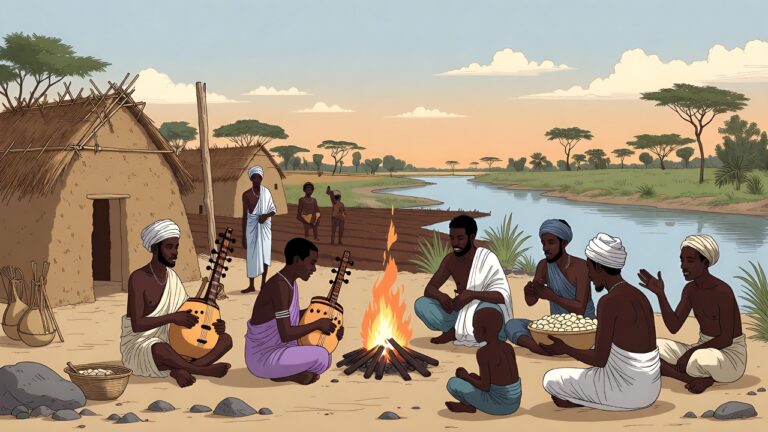
The first thing you hear as morning breaks over the Gambia River is the soft, rhythmic sound of a kora gently struck, mingled with the distant call of a hornbill and the scent of freshly cooked domoda and smoked fish drifting from a nearby home. That kora sound carries our story back to a time of rivers and oneness, when we as the Mandinka, Wolof, Fula, Jola and Serer lived along the Gambia River that cuts through our land like a silver ribbon. Our ancestors built villages of mud and thatch, grew peanuts and rice on the fertile banks, traded across the river in canoes. The Mandinka knew their griots who told stories on the kora, the Wolof their language of honour and hospitality, the Fula their cattle that meant wealth. Every family knew the ceremonies of initiation, the sabar dances that filled the night with rhythm, the communities where sharing was natural and respect for the elders was law. That was our golden time: a land of river and savannah, where people lived in harmony with the Gambia as mother and the sun as father, connected by music and stories.
But then came the wave from outside, like a storm rising from the Atlantic Ocean. The Portuguese arrived in the 15th century, followed by the British who made us a colony in 1888. They cut our land in two with the river as border, took our soil, forced us to work on peanut plantations. Every family knew the loss: an ancestor who worked for strangers, a language that had to survive alongside English, a culture that adapted to endure. Independence in 1965 brought Dawda Jawara – hope that lasted decades – but also a coup in 1981 and tensions with Senegal that nearly swallowed us. Every family knew the unrest, the silence in the villages, the emigration that carried many across the sea.
From that depth rises a pride that is warm and welcoming. The kora that still tells stories, the domoda shared with love, the sabar dance that lets the hips speak. Our people who laugh through hardships, our youth dreaming of a better land, our river that always feeds us. We have found our voice again: the democracy that is growing, the tourism that shows our country, the music of Youssou N’Dour that touches the world.
Yet the truth colours magenta like a sunset over the Gambia River. The scars remain: poverty along the river, the emigration of youth, climate change threatening the harvests, corruption that sometimes returns. The outside world buys our peanuts and our tourism, but often does not see the pain of the colonial legacy, the struggle for unity.
Still, we remember in silence: around the kora where stories are sung, on Independence Day the 18th of February when we raise our flag, in the villages where the river still whispers – never forgetting who we were. We tell our children of the Mandinka and of Jawara, of the river and the savannah, so they know: we were connected and strong before we were challenged.
And yet… the kora continues, soft and deep, like a promise that floats over the river. That is our secret: we have suffered under colonisation, unrest and division, but first we were a land of river and music. For our children we build no walls, but a kora circle where everyone may join in playing. How do we let that kora sound bring hope to all once more, how does The Gambia remain a home of hospitality and rhythm?
January 2026
Manna Ori