
Through the Eyes of the Guatemalan
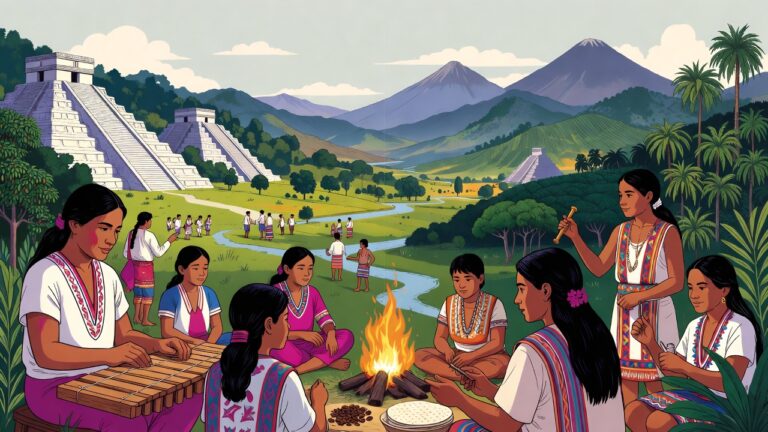
The first thing you hear as morning breaks over a village near Antigua is the soft striking of a few notes on a marimba, the sound travelling over hills full of coffee plantations and mingling with the scent of freshly ground coffee beans and maize tortillas sizzling on a comal. That marimba sound carries our story back to a time of mountains and ancient cities, when we as the Maya lived in this land we called Ixil, K'iche', Kaqchikel and more. Our ancestors built pyramids in Tikal and Quiriguá that seemed to touch the sky, wrote books full of knowledge in hieroglyphs, grew maize as a sacred gift from the gods. They lived in harmony with the volcanoes as father and the earth as mother: shamans who spoke with the spirits of mountain and river, markets where cacao and quetzal feathers were traded, communities where the Popol Vuh was read aloud by the fire. Every family knew the ceremonies of the 260-day calendar, the dances that celebrated the cycle of life, the connectedness stronger than time. That was our golden time: a land of volcanoes and jungle, where people lived with the stars as guides and nature as temple, rich in knowledge and unity.
But then came the wave from outside, like a storm rising from the mountains. The Spaniards arrived in 1524 with Pedro de Alvarado, and within years our cities fell. They took our gold, our people as slaves, our codices as pagan. Every family knew the loss: an ancestor who disappeared into the encomienda, a language that had to survive in secret, a culture that blended to endure. Independence in 1821 brought hope, but also centuries of dictatorships and inequality. The civil war from 1960 to 1996 was hell: genocide against the Maya, more than 200,000 dead, villages burned, families fleeing. Every family knew someone who disappeared, a child who grew up in fear, a silence that carried across generations.
From that depth rises a pride that is deep and colourful. The marimba that still sounds in the villages, the huipiles woven by hand in patterns that tell stories, the coffee from the volcanoes that wakes the world. Our people who laugh through pain, our youth rising for justice, our traditions that never fully died. We have found our voice again: the peace accords of 1996, the indigenous peoples claiming their rights, the hope that grows.
Yet the truth colours magenta like a sunset over Pacaya volcano. The scars remain: poverty in the highlands, corruption that sometimes returns, the emigration of youth, the memory of the genocide. The outside world buys our coffee and our tourism, but often does not feel the depth of a people that never broke.
Still, we remember in silence: around the marimba where music is made, on Independence Day the 15th of September when we raise our flag, in the mountains where the spirits still speak – never forgetting who we were. We tell our children of the Maya and of the peace accords, of the volcanoes and the rivers, so they know: we were connected and strong before we were challenged.
And yet… the marimba continues, warm and rhythmic, like a promise that floats over the hills. That is our secret: we have suffered under colonisation, genocide and unrest, but first we were a land of pyramids and knowledge. For our children we build no walls, but a marimba circle where everyone may join in playing. How do we let that marimba sound bring hope to all once more, how does Guatemala remain a home of colour and resilience?
January 2026
Manna Ori
A Través de los Ojos del Guatemalteco
Lo primero que oyes cuando la mañana se levanta sobre un pueblito cerca de Antigua es el suave golpeteo de unas notas en una marimba, el sonido viaja por las colinas llenas de cafetales y se mezcla con el aroma de granos de café recién molidos y tortillas de maíz chisporroteando en un comal. Ese sonido de marimba lleva nuestra historia de vuelta a un tiempo de montañas y ciudades antiguas, cuando nosotros como mayas vivíamos en esta tierra que llamábamos Ixil, K'iche', Kaqchikel y más. Nuestros ancestros construyeron pirámides en Tikal y Quiriguá que parecían tocar el cielo, escribieron libros llenos de conocimiento en jeroglíficos, cultivaron maíz como regalo sagrado de los dioses. Vivían en armonía con los volcanes como padre y la tierra como madre: chamanes que hablaban con los espíritus de montaña y río, mercados donde se intercambiaba cacao y plumas de quetzal, comunidades donde el Popol Vuh se leía en voz alta junto al fuego. Cada familia sabía las ceremonias del calendario de 260 días, las danzas que celebraban el ciclo de la vida, la conexión más fuerte que el tiempo. Esa fue nuestra época dorada: una tierra de volcanes y selva, donde la gente vivía con las estrellas como guías y la naturaleza como templo, rica en conocimiento y unidad.
Pero entonces llegó la ola de afuera, como una tormenta que se levantó de las montañas. Los españoles llegaron en 1524 con Pedro de Alvarado, y en pocos años nuestras ciudades cayeron. Tomaron nuestro oro, nuestra gente como esclavos, nuestros códices como paganos. Cada familia sabía la pérdida: un ancestro que desapareció en la encomienda, una lengua que tuvo que sobrevivir en secreto, una cultura que se mezcló para perdurar. La independencia en 1821 trajo esperanza, pero también siglos de dictaduras y desigualdad. La guerra civil de 1960 a 1996 fue un infierno: genocidio contra los mayas, más de 200.000 muertos, aldeas quemadas, familias huyendo. Cada familia sabía de alguien que desapareció, un niño que creció con miedo, un silencio que cargaron generaciones.
De esa profundidad surge un orgullo profundo y colorido. La marimba que aún suena en los pueblos, los huipiles tejidos a mano en patrones que cuentan historias, el café de los volcanes que despierta al mundo. Nuestra gente que ríe a través del dolor, nuestra juventud que se levanta por justicia, nuestras tradiciones que nunca murieron del todo. Hemos recuperado nuestra voz: los acuerdos de paz de 1996, los pueblos indígenas reclamando sus derechos, la esperanza que crece.
Sin embargo la verdad se tiñe de magenta como un atardecer sobre el volcán Pacaya. Las cicatrices permanecen: la pobreza en las tierras altas, la corrupción que a veces regresa, la emigración de los jóvenes, el recuerdo del genocidio. El mundo exterior compra nuestro café y nuestro turismo, pero a menudo no siente la profundidad de un pueblo que nunca se rompió.
Aun así recordamos en silencio: alrededor de la marimba donde se hace música, en el Día de la Independencia el 15 de septiembre cuando izamos nuestra bandera, en las montañas donde los espíritus aún hablan – nunca olvidamos quiénes fuimos. Contamos a nuestros hijos sobre los mayas y los acuerdos de paz, sobre los volcanes y los ríos, para que sepan: estábamos conectados y fuertes antes de ser desafiados.
Y sin embargo… la marimba continúa, cálida y rítmica, como una promesa que flota sobre las colinas. Ese es nuestro secreto: hemos sufrido bajo colonización, genocidio e inquietud, pero primero fuimos una tierra de pirámides y conocimiento. Para nuestros hijos no construimos muros, sino un círculo de marimba donde todos puedan tocar. ¿Cómo dejamos que ese sonido de marimba traiga esperanza a todos una vez más, cómo Guatemala sigue siendo un hogar de color y resiliencia?
Enero 2026 Manna Ori