
Through the Eyes of the Bissau-Guinean
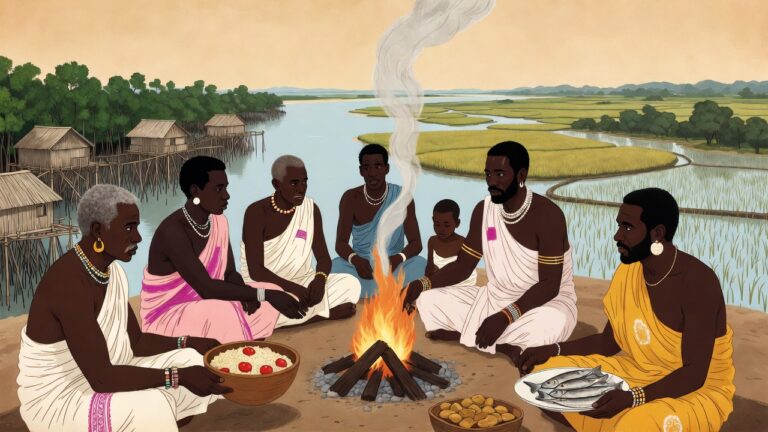
The first thing you hear as morning breaks over the coast of Bissau is the soft, rolling sound of a balafon striking one note, mingled with the distant call of an osprey and the scent of freshly cooked arroz de tomate and smoked fish drifting from a nearby house. That balafon sound carries our story back to a time of mangroves and rivers, when we as the Balanta, Fula, Mandinka, Papel and other peoples lived in this land we called Guiné. Our ancestors built villages on stilts in the mangroves, fished with canoes in the Bijagós archipelago, grew rice in fertile deltas. The Balanta knew their sacred forests and knowledge of nature, the Fula their cattle and nomadic routes, the Papel their masks that spoke to the spirits. Every family knew the stories of the ancestors, the dances around the fire that filled the night with rhythm, the communities where sharing was natural and respect for the elders was law. That was our golden time: a land of islands and rivers, where people lived in harmony with the sea as mother and the mangroves as father, connected by music and respect.
But then came the wave from outside, like a storm rising from the Atlantic Ocean. The Portuguese colonised us in the 15th century, made us a trading post for slaves and later a plantation colony of cashew and peanuts. They took our land, forced us to work, drew our borders without respect for peoples. Every family knew the loss: an ancestor who came in chains, a language that had to survive alongside Portuguese, a culture that adapted to endure. The independence struggle from 1963 to 1974 was hell: guerrilla in the jungle, thousands dead, Amílcar Cabral murdered in 1973. Every family knew the fear, the disappearances, the silence in the villages.
From that depth rises a pride that is warm and rhythmic. The balafon that still sounds in the villages, the arroz de tomate shared with love, the Mandinka dances that fill the night. Our cashew that feeds the world, our people who laugh through hardships, our youth dreaming of a better land. We have found our voice again: independence in 1974, the democracy that grows, the hope Cabral left behind.
Yet the truth colours magenta like a sunset over the Bijagós islands. The scars remain: poverty in the villages, corruption that sometimes returns, the emigration of youth, the memory of the liberation struggle. The outside world buys our cashew and our fish, but often does not see the pain of the colonial legacy, the struggle for justice.
Still, we remember in silence: around the balafon where music is made, on Independence Day the 24th of September when we raise our flag, in the mangroves where the spirits still speak – never forgetting who we were. We tell our children of the old kingdoms and of Cabral, of the rivers and the islands, so they know: we were connected and strong before we were challenged.
And yet… the balafon continues, soft and deep, like a heartbeat that never falls silent. That is our secret: we have suffered under colonisation, struggle and poverty, but first we were a land of rivers and music. For our children we build no walls, but a village square where everyone may join in playing. How do we let that balafon sound bring hope to all once more, how does Guinea-Bissau remain a home of rhythm and unity?
January 2026
Manna Ori
Na Olhos di Guineense-Bissau
Primeiru sonu ku bu oi kuma manhan ta txiga riba di kosta di Bissau i suavi, rolanti txamada di balafon ku ta bati un nota, misturadu wid lontanu krae di fisiu pa Zambezi an cheiru di arroz di tomate fresku an isabi fumadu ku ta sai di kasa pertu. Es txamada di balafon ta leba nos istória pa trás pa tempu di mangal an riu, kuma nos ta vivi komu Balanta, Fula, Mandinka, Papel an otu povu na es terra ku nos ta txamaba Guiné. Nos avó ta monta aldea riba palu na mangal, ta faifaiva wid kanoa na Arquipélagu di Bissagos, ta kuda arroz na delta fertil. Balanta ta konxe bosque sagradu an sabi di natura, Fula ta guarda baka an ruta nomadiku, Papel ta konxe máscara ku ta fala wid espírito. Kada família ta konxe istória di avó, dansa na volta di fugu ku ta fuluma noti wid ritmu, komunidade wey partilha normal an rispetu pa mas velhu i lei. Es era nos tempu di ouro: terra di ilha an riu; mar komu mai, mangal komu pai, ligadu pa música an rispetu.
Mas dipos ta ben onda di fora, ta subi komu furakán di Atlântiku. Portugues ta koloniza nos na sékulu XV, ta transforma nos na posto di komersiu di esklavu i dipos kolónia di plantason di caju an pinda. Oli ta toma nos terra, ta força nos pa trabadju, ta korti nos fronteira sin rispetu pa povu. Kada família ta konxe perda: avó ku ta leva na kadeia, lingua ku ta sobrevive al lado di Portugues, kultura ku ta adapta pa dura. Luta pa independênsia di 1963 te 1974 i infernu: guerrilha na matu, milhar di mortu, Amílcar Cabral mortu na 1973. Kada família ta konxe medo, desaparison, silênsiu na aldea.
Di es profundesa ta subi orgulhu ku ta kala an ritmiku. Balafon ta kontinua ta bati na aldea, arroz di tomate ta partilha wid amor, dansa di Mandinka ta fuluma noti. Nos caju ta alimenta mundu, nos povu ta sorrí na difikuldadi, nos juventudi ta leva sonhu pa Guiné mas bon. Nos ta rekupe nos voz: independênsia na 1974, democracia ku ta kresi, esperansa ku Cabral ta dexa.
Mas verdadi ta pinta magenta komu sol ta baxada riba ilha di Bissagos. Marka ta fika: guerra ku ta kontinua, júu ku ta pega milihon, emigrasion di juventudi, memória di luta di liberta. Mundu di fora ta kumpra nos caju an peixe, mas kuazi nunka ta senti dor di eransa kolonial, nunka ta luta pa justisa.
Inda sim, nos ta lembra na silênsiu: na volta di balafon wey música ta nasse, na Dia di Independênsia 24 di setembru ku nos ta sobi bandeira, na mangal wey espírito ta fala inda—nunka ta esquece ken nos era. Nos ta konta nos mininu di reino antigu an Cabral, di riu an ilha, pa eles sabe: nos era ligadu an forti antes di difikuldadi ta ben.
I inda sim… balafon ta kontinua, suavi an profundu, komu korason ku ta bati sempri. Es i nos segredu: nos ta sofre na kolonizasi, luta an pobreza, mas primeru nos era terra di riu an música. Pa nos mininu nos nunka ta monta parede, mas un prasa di aldea wey tudu gentis ta pudi joga. Kuma nos ta faze es txamada di balafon ta traze esperansa outra vez pa tudu? Kuma Guiné-Bissau ta fika kasa di ritmu an unida?
Janeiro 2026
Manna Ori