
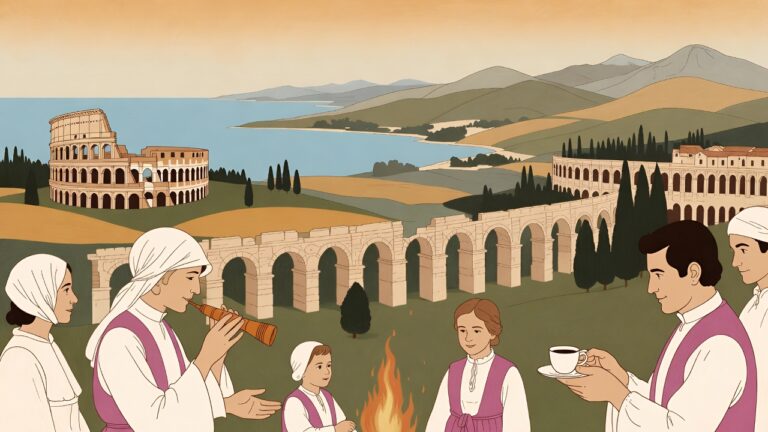
Through the Eyes of the Italian
The first thing you hear as morning comes over Rome is the soft, warm sound of a church bell striking once fromthe dome of St. Peter’s, blending with the distant buzz of scooters on the Via del Corso and the scent of freshlybaked cornetto and espresso drifting from a bar. That bell chime carries our story back to a time of emperors andrepublics, when we lived as the heart of Rome and later of the Renaissance. Our ancestors built the Colosseum,the aqueducts, the roads that connected the world, wrote the laws that still form the basis of justice. The republicgave us Cicero and Caesar, the emperors built the Pantheon that brought the sky inside, the Renaissancebrought Michelangelo, Leonardo, and the Sistine Chapel. We lived in harmony with the Mediterranean as motherand the Apennines as father: poets like Dante and Petrarch who touched the soul, painters who celebratedhuman beauty, families who ate and laughed together over pasta and wine. Every family knew the tales ofRomulus and Remus, the feasts of Carnevale, the bond stronger than time. That was our golden time: a land ofart, science, and passion, where people lived with history as guide and beauty as compass, bound by food, love,and creation.
But then came the wave from outside, like a storm rising from the past. The barbarians sacked Rome in 410 and455, the Middle Ages brought division, foreign powers kept us fragmented for centuries. Unification in 1861brought Garibaldi and Cavour, but also world wars, fascism under Mussolini, and World War II with ruined citiesand torn families. Every family knew the loss: a grandfather in the trenches, an uncle in the resistance, a childwho learned that freedom costs blood. The smell of smoke, the silence after bombs, the emptiness in the streetsof Naples and Florence.
From that depth rises a pride that is warm and expressive. The pasta still made by hand, the opera of Puccinithat touches the soul, the Vespa zipping through the streets. Our art from Michelangelo and Caravaggio, ourwine from Tuscany, our people who laugh through difficulties. We have found our voice again: democracy afterthe war, economic miracles, creativity that never dies.
Yet the truth colors magenta like a sunset over the Tiber. The scars remain: the memory of wars, the emigrationof youth, the political division that sometimes returns, the pressure of a fast-changing world. The outside worldbuys our fashion and our pasta, but often does not feel the depth of a people that always rises again.
Still, we remember in silence: on the piazzas where laughter rings, during Festa della Repubblica on June 2when we raise our flag, in the streets where the spirits still speak—we never forget who we were. We tell ourchildren of Rome and of Garibaldi, of the sea and the mountains, so they know: we were connected and strongbefore we were challenged.
And yet… the bell chime continues, soft and warm, like a promise that Rome always rises again. That is oursecret: we have suffered under plundering, wars, and division, but first we were a land of art and passion. Forour children we build no walls, but a piazza where everyone may laugh and debate. How do we let that bellchime bring unity to everyone again? How does Italy remain a home of beauty and joy?
January 2026
Manna Ori
Attraverso gli Occhi dell'Italiano
La prima cosa che senti quando il mattino arriva su Roma è il suono morbido e caldo di una campana che batte una volta dalla cupola di San Pietro, mescolato al lontano brusio di scooter su Via del Corso e all’aroma di cornetto appena sfornato ed espresso che esce da un bar. Quel suono di campane porta la nostra storia indietro a un’epoca di imperatori e repubbliche, quando vivevamo come cuore di Roma e poi del Rinascimento. I nostri antenati costruirono il Colosseo, gli acquedotti, le strade che unirono il mondo, scrissero le leggi che ancora oggi formano la base della giustizia. La repubblica ci diede Cicerone e Cesare, gli imperatori eressero il Pantheon che portava il cielo dentro, il Rinascimento portò Michelangelo, Leonardo e la Cappella Sistina. Vivevamo in armonia con il Mediterraneo come madre e gli Appennini come padre: poeti come Dante e Petrarca che toccavano l’anima, pittori che celebravano la bellezza umana, famiglie che mangiavano e ridevano insieme su pasta e vino. Ogni famiglia conosceva le storie di Romolo e Remo, le feste del Carnevale, il legame più forte del tempo. Quello era il nostro tempo d’oro: una terra d’arte, scienza e passione, dove le persone vivevano con la storia come guida e la bellezza come bussola, unite dal cibo, dall’amore e dalla creazione.
Ma poi arrivò l’onda da fuori, come una tempesta che si alza dal passato. I barbari saccheggiarono Roma nel 410 e nel 455, il Medioevo portò divisione, le potenze straniere ci tennero frammentati per secoli. L’unificazione nel 1861 portò Garibaldi e Cavour, ma anche guerre mondiali, fascismo sotto Mussolini, e la Seconda Guerra Mondiale con città devastate e famiglie spezzate. Ogni famiglia conobbe la perdita: un nonno nelle trincee, uno zio nella Resistenza, un bambino che imparò che la libertà costa sangue. L’odore di fumo, il silenzio dopo le bombe, il vuoto nelle strade di Napoli e Firenze.
Da quella profondità sale un orgoglio caldo ed espressivo. La pasta ancora fatta a mano, l’opera di Puccini che tocca l’anima, la Vespa che sfreccia per le vie. La nostra arte di Michelangelo e Caravaggio, il nostro vino toscano, la nostra gente che ride nonostante le difficoltà. Abbiamo ritrovato la nostra voce: la democrazia dopo la guerra, i miracoli economici, la creatività che non muore mai.
Eppure la verità si tinge di magenta come un tramonto sul Tevere. Le cicatrici restano: il ricordo delle guerre, l’emigrazione dei giovani, la divisione politica che a volte ritorna, la pressione di un mondo che cambia veloce. Il mondo esterno compra la nostra moda e la nostra pasta, ma spesso non sente la profondità di un popolo che si rialza sempre.
Tuttavia ricordiamo in silenzio: sulle piazze dove risuona la risata, durante la Festa della Repubblica il 2 giugno quando alziamo la bandiera, nelle strade dove gli spiriti ancora parlano – non dimentichiamo mai chi eravamo. Raccontiamo ai nostri figli di Roma e di Garibaldi, del mare e delle montagne, affinché sappiano: eravamo uniti e forti prima di essere sfidati.
Eppure… il suono delle campane continua, morbido e caldo, come una promessa che Roma si rialza sempre. Questo è il nostro segreto: abbiamo sofferto saccheggi, guerre e divisioni, ma prima eravamo una terra d’arte e passione. Per i nostri figli non costruiamo muri, ma una piazza dove tutti possano ridere e discutere. Come facciamo risuonare di nuovo quel suono di campane per portare unità a tutti? Come rimane l’Italia una casa di bellezza e gioia?
Gennaio 2026
Manna Ori