
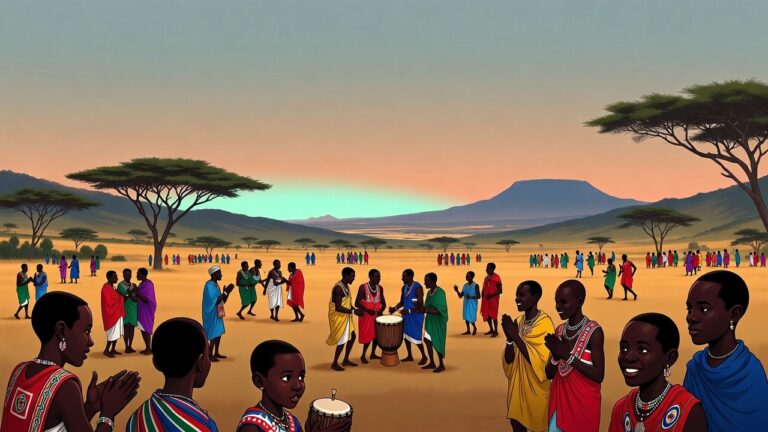
Through the Eyes of the Kenyan
The first thing you hear as morning comes over the savannah of the Masai Mara is the soft, deep sound of a drum beating once in a nearby village, blending with the distant roar of a lion and the scent of fresh ugali and roasted meat drifting from a nearby home. That drumbeat carries our story back to a time of savannah and horizon, when we lived as the Kikuyu, Luo, Kalenjin, Maasai, Luhya, Kamba, and many other peoples in this land we called Kenya. Our ancestors built villages of mud and grass, herded cattle that meant wealth and status, cultivated sorghum and maize in the fertile highlands. The Maasai knew their moran warriors and their knowledge of nature, the Kikuyu their sacred mountains and Gikuyu stories, the Luo their fishing nets along Lake Victoria. Every family knew the initiation ceremonies, the dances around the fire that filled the night with rhythm, the communities where sharing was normal and respect for elders was law. That was our golden time: a land of savannah, mountains, and lakes, where people lived in harmony with nature as mother and the horizon as father, bound by cattle, stories, and rhythm.
But then came the wave from outside, like a storm rising from the sea. The British colonized us in the 19th century, called us British East Africa, and took our land for white settlers. Every family knew the loss: an ancestor who lost land in the White Highlands, a child who had to speak Kikuyu or Luo in secret, a culture that had to adapt to survive. The Mau Mau uprising in the 1950s was a bloody struggle for freedom—tens of thousands dead, prisons, torture. Independence in 1963 brought Jomo Kenyatta—growing hope—but also the challenges of a young nation: tribal conflicts, corruption, pressure from foreign influences.
From that depth rises a pride that is warm and rhythmic. The Maasai who still walk the savannah, the nyama choma prepared with love, the marathon runners who make the world run. Our music of benga and genge that fills the night, our people who laugh through hardships, our youth who rise for a better land. We have found our voice again: the democracy that grows, the hope that still burns in the highlands.
Yet the truth colors magenta like a sunset over the Rift Valley. The scars remain: poverty in the slums, tensions between tribes, the emigration of youth, the memory of the Mau Mau. The outside world buys our safaris and our tea, but often does not feel the depth of a people that never broke.
Still, we remember in silence: around the drum where stories are told, on Independence Day on December 12 when we raise our flag, in the savannah where the spirits still speak—we never forget who we were. We tell our children of the Mau Mau and of Kenyatta, of the savannah and the mountains, so they know: we were connected and strong before we were challenged.
And yet… the drum continues, deep and low, like a heartbeat that never falls silent. That is our secret: we have suffered under colonization, struggle, and unrest, but first we were a land of savannah and rhythm. For our children we build no walls, but a savannah where everyone may run. How do we let that drumbeat bring unity to everyone again? How does Kenya remain a home of strength and laughter?
January 2026
Manna Ori
Kupitia Macho ya Mkenya
Jambo la kwanza unalosikia asubuhi inapofika juu ya savanna ya Masai Mara ni sauti laini na ya kina ya ngoma inayopigwa mara moja katika kijiji kilicho karibu, ikichanganyika na mngurumo wa mbali wa simba na harufu ya ugali mpya na nyama choma inayotoka nyumbani karibu. Sauti hiyo ya ngoma inabeba hadithi yetu kurudi wakati wa savanna na upeo wa macho, wakati tulipokuwa Kikuyu, Luo, Kalenjin, Maasai, Luhya, Kamba na makabila mengine mengi katika nchi hii tuliyoiita Kenya. Mababu zetu walijenga vijiji vya udongo na nyasi, walifuga mifugo ambayo ilimaanisha utajiri na hadhi, walipanda mtama na mahindi katika nyanda za juu zenye rutuba. Wamaasai walijua walinzi wao wa moran na ujuzi wao wa asili, Wakikuyu milima yao takatifu na hadithi za Gikuyu, Waluo wavu zao kando ya Ziwa Victoria. Kila familia ilijua sherehe za uanzishaji, ngoma karibu na moto zilizojaza usiku kwa midundo, jamii ambapo kushiriki ilikuwa kawaida na heshima kwa wazee ndiyo sheria. Hiyo ilikuwa wakati wetu wa dhahabu: nchi ya savanna, milima na maziwa, ambapo watu waliishi kwa upatano na asili kama mama na upeo wa macho kama baba, wakiunganishwa na mifugo, hadithi na midundo.
Lakini kisha wimbi kutoka nje likaja, kama dhoruba inayotoka baharini. Waingereza walitukoloni katika karne ya 19, wakaitumia British East Africa na kuchukua ardhi yetu kwa wakulima weupe. Kila familia ilijua hasara: babu ambaye alipoteza ardhi katika White Highlands, mtoto ambaye alilazimika kuzungumza Kikuyu au Luo kwa siri, utamaduni ambao ulilazimika kubadilika ili kuishi. Uasi wa Mau Mau katika miaka ya 50 ulikuwa mapambano ya umwagaji damu kwa uhuru—makumi ya maelfu waliuawa, magereza, mateso. Uhuru mwaka 1963 ulileta Jomo Kenyatta—matumaini yaliyokua—lakini pia changamoto za nchi mpya: migogoro ya makabila, ufisadi, shinikizo kutoka ushawishi wa nje.
Kutoka kwa kina hicho kunatoka fahari ambayo ni ya joto na yenye midundo. Wamaasai wanaotembea bado savanna, nyama choma inayotayarishwa kwa upendo, wakimbiaji wa marathon wanaofanya dunia kukimbia. Muziki wetu wa benga na genge unaojaza usiku, watu wetu wanaocheka licha ya ugumu, vijana wetu wanaoinuka kwa nchi bora. Tumepata tena sauti yetu: demokrasia inayokua, matumaini yanayowaka bado katika nyanda za juu.
Lakini ukweli unapaka magenta kama machweo juu ya Rift Valley. Makovu yanabaki: umaskini katika mitaa duni, mvutano kati ya makabila, uhamiaji wa vijana, kumbukumbu ya Mau Mau. Ulimwengu wa nje unanunua safari zetu na chai yetu, lakini mara nyingi hauhisi kina cha watu ambao hawakuvunjika kamwe.
Hata hivyo tunakumbuka kwa utulivu: karibu na ngoma ambapo hadithi zinasimuliwa, wakati wa Siku ya Uhuru tarehe 12 Desemba tunapoinua bendera yetu, katika savanna ambapo mizimu bado inazungumza—hatutawahi kusahau tulivyokuwa. Tunawaambia watoto wetu kuhusu Mau Mau na Kenyatta, savanna na milima, ili wajue: tulikuwa wamoja na wenye nguvu kabla ya kupimwa.
Na bado… ngoma inaendelea, ya kina na ya chini, kama mapigo ya moyo yasiyotulia kamwe. Hiyo ndiyo siri yetu: tumeteseka chini ya ukoloni, mapambano na machafuko, lakini kwanza tulikuwa nchi ya savanna na midundo. Kwa watoto wetu hatujengi kuta, bali savanna ambapo kila mtu anaweza kukimbia. Je, tunafanya sauti hiyo ya ngoma ilete umoja kwa kila mtu tena? Je, Kenya inabaki nyumba ya nguvu na kicheko?
Januari 2026
Manna Ori