
Through the Eyes of the Mosotho
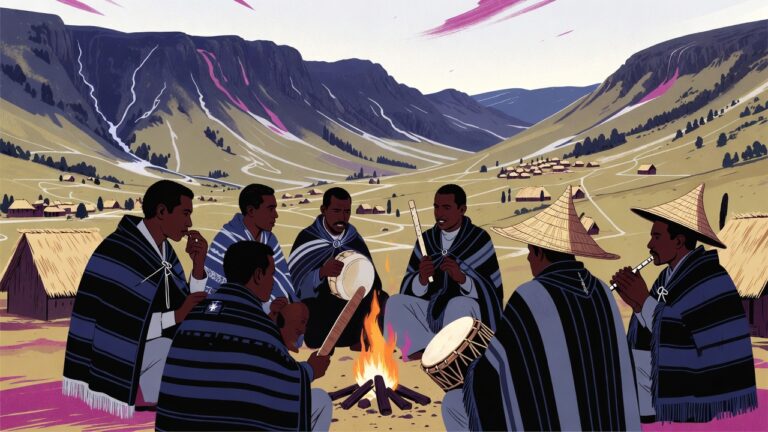
The first thing you hear as morning arrives over the Maloti Mountains is the soft, rhythmic sound of a moropadrum struck once, mingled with the distant whinny of a horse and the scent of fresh papa (maize porridge) andmoroho (greens) drifting from a nearby rondavel. That drumbeat carries our story back to a time of highmountains and freedom, when we, as the Basotho, lived in this land we call Lesotho. Our ancestors built villageson steep slopes, herded cattle that meant wealth and status, grew sorghum and maize in fertile valleys. KingMoshoeshoe I united the clans, led us to Thaba Bosiu—the mountain of the night—where we held firm againstenemies. Every family knew the tales of the ancestors, the mokorotlo dances that showed the strength ofwarriors, communities where sharing was natural and respect for the morena (chief) was law. That was ourgolden time: a land of mountains and sky, where people lived in harmony with the highlands as father and therivers as mother, connected through cattle, song, and courage.
But then came the wave from outside, like a storm rising from the west. The Boers and British tried to take ourland in the 19th century, but Moshoeshoe stood firm and sought protection from the British Crown. In 1868 webecame a British protectorate, and in 1966 independent as Lesotho. Every family knew the loss: land ceded toSouth Africa, a people enclosed within a larger country, a culture that had to adapt to modern times. Apartheid inSouth Africa pressed heavily on us, political unrest in the 90s and 2000s brought coups and tensions. Everyfamily knew the unrest, the migration to mines in South Africa, the silence in the mountain villages.
From that depth rises a pride that is deep and resilient. The moropa drum that still beats in the villages, thebasotho blanket (selesele) woven by hand, the horses galloping over the mountains. Our people who laughthrough hardships, our youth who dream of a better land, our connectedness stronger than the heights. We havefound our voice again: the democracy that grows, the hope that still burns in the highlands.
Yet the truth colors magenta like a sunset over the Maloti. The scars remain: poverty in the mountain villages,migration to South Africa, the pressure of climate change on our farming, the memory of colonial times. Theoutside world buys our wool and our tourism, but often does not feel the depth of a people that never broke.
Still, we remember in silence: around the fire where the moropa sounds, during Independence Day on 4 Octoberwhen we raise our flag, in the mountains where spirits still speak—never forgetting who we were. We tell ourchildren of Moshoeshoe and of independence, of the mountains and the rivers, so they know: we wereconnected and strong before we were challenged.
And yet… the moropa continues, deep and low, like a heartbeat that never falls silent. That is our secret: wehave suffered under colonization, unrest, and altitude, but we were first a land of mountains and cattle. For ourchildren we build no walls, but a kraal where everyone may enter. How do we let that drumbeat bring unity toeveryone again, how does Lesotho remain a home of courage and horizon?
January 2026
Manna Ori
Ka mahlo a Mosotho
Ntho ea pele eo u e utloang ha hoseng ho fihla holim'a Lithaba tsa Maloti ke molumo o bonolo, o nang le morethetho oa moropa o otloang hang feela, o tsoakaneng le ho lla ha pere hole-hole le monko oa papa e sa tsoa etsoa (papa ea poone) le moroho o tsoang ntlong e haufi ea rondavel. Molumo oo oa moropa o isa pale ea rona morao mehleng ea lithaba tse phahameng le bolokolohi, ha re ne re phela re le Basotho naheng ena eo re e bitsang Lesotho. Baholo-holo ba rona ba ile ba haha metse holim'a matsoapo a moepa, ba fepa likhomo tse neng li bolela leruo le boemo, ba lema mabele le poone liphuleng tse nonneng. Morena Moshoeshoe I o ile a kopanya merabe, a re isa Thaba Bosiu—thaba ea bosiu—hoo re ileng ra ema teng khahlanong le lira. Lelapa le leng le le leng le ne le tseba lipale tsa baholo-holo, metjeko ea mokorotlo e bontšang matla a bahlabani, sechaba seo ho arolelana e neng e le ntho e tloaelehileng le tlhompho ho morena e neng e le molao. E ne e le nako ea rona ea khauta: naha ea lithaba le leholimo, moo batho ba neng ba phela ka tumellano le lihlabeng e le ntate le linōka e le 'mè, ba kopane ka likhomo, lipina le sebete.
Empa joale ha tla leqhubu le tsoang kantle, joaloka sefefo se tsoang bophirimela. Maburu le Mabrithani ba ile ba leka ho nka naha ea rona lekholong la bo19 la lilemo, empa Moshoeshoe o ile a ema ka tieo 'me a kōpa tšireletso ho moqhaka oa Brithani. Ka 1868 re ile ra fetoha tšireletso ea Brithani, 'me ka 1966 ra ipusa e le Lesotho. Lelapa le leng le le leng le ile la tseba tahlehelo: naha e ileng ea fanoa Afrika Boroa, sechaba se ileng sa koalloa ka har'a naha e kholoanyane, setso se ileng sa tlameha ho ikamahanya le linako tsa sejoale-joale. Apartheid Afrika Boroa e ile ea re hatella haholo, merusu ea lipolotiki lilemong tsa bo-90 le bo-2000 ea tlisa likhohlano le likhohlano. Lelapa le leng le le leng le ile la tseba merusu, ho falla ho ea merafong Afrika Boroa, khutso metsaneng ea lithaba.
Ho tloha botebong boo ho hlaha boikhohomoso bo tebileng le bo mamellang. Moropa o ntseng o otla metsaneng, selesele sa Basotho se lohiloeng ka matsoho, lipere tse mathang holim'a lithaba. Batho ba rona ba tšeha har'a mathata, bacha ba rona ba lorang ka naha e betere, kopano ea rona e matla ho feta bophahamo. Re fumane lentsoe la rona hape: demokrasi e ntseng e hōla, tšepo e ntseng e chesa lihlabeng.
Empa 'nete e mebala magenta joaloka letsatsi le likela holim'a Maloti. Mabali a ntse a le teng: bofuma metsaneng ea lithaba, ho falla ho ea Afrika Boroa, khatello ea phetoho ea boemo ba leholimo temong ea rona, mohopolo oa nako ea bokolone. Lefatše le ka ntle le reka boea ba rona le bohahlauli ba rona, empa hangata ha le utloe botebo ba sechaba se sa kang sa robeha.
Leha ho le joalo, re hopola ka khutso: haufi le mollo moo moropa o llang teng, ka Letsatsi la Boipuso ka la 4 Mphalane ha re phahamisa folakha ea rona, lithabeng moo meea e ntseng e bua—ha re lebale le ka mohla hore na re ne re le mang. Re bolella bana ba rona ka Moshoeshoe le ka boipuso, ka lithaba le linōka, e le hore ba tsebe: re ne re kopane ebile re matla pele re lekoa.
'Me leha ho le joalo… moropa o tsoela pele, o tebile ebile o tlaase, joaloka ho otla ha pelo ho sa kang ha khutsa. Ke lekunutu la rona: re ile ra utloa bohloko tlas'a bokolone, merusu le bophahamo, empa re ne re le naha ea lithaba le likhomo pele ho tsohle. Bakeng sa bana ba rona ha re ahe marako, empa re haha lesakana leo mang le mang a ka kenang ho lona. Re tla etsa joang hore molumo oo oa moropa o tle o tlise bonngoe ho bohle hape, Lesotho e lule e le lehae la sebete le bokahohlane?
Pherekhong 2026
Manna Ori