Through the Eyes of the Mauritanian
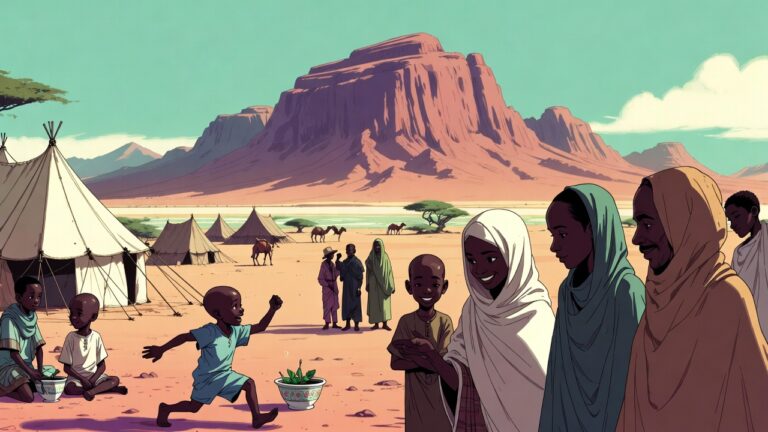
The first sound you hear as morning arrives over the Adrar mountains is the soft, deep note of a tidinit striking a single string, mingled with the distant neigh of a camel and the scent of fresh mint tea and roasted meat drifting from a nearby tent camp. That string-sound carries our story back to a time of desert and caravans, when we lived as the Moors, Wolof, Soninke, Pulaar, and other peoples in this land we called Muritaniya. Our ancestors crossed the Sahara with camels, mastered the trans-Saharan trade in salt and gold, built cities like Chinguetti and Ouadane where manuscripts were preserved in sandstone libraries. The Moors knew their Hassaniya poetry and their knowledge of the desert, the Wolof their hospitality and markets, the Pulaar their cattle and nomadic routes. Every family knew the tales of the ancestors, the feasts of Eid where everyone gathered, the bond stronger than the heat. That was our golden time: a land of desert and oases, where people lived in harmony with the Sahara as mother and the caravans as father, connected by tea, poetry, and hospitality.
But then came the wave from outside, like a storm rising from the desert itself. The French colonized us in the 19th century, called us French West Africa, and turned us into a source of labor and raw materials. Every family knew the loss: an ancestor who worked for strangers, a language that had to survive beside French, a culture held in secret. Independence in 1960 brought Moktar Ould Daddah – hope that grew – but also tensions between north and south, slavery that persisted long despite bans, the coups and dictatorships that followed. Every family knew the unrest, the emigration to Europe and within Mauritania itself, the silence in the villages.
From that depth rises a pride that is deep and welcoming. The tidinit that still plays poetry, the tea served in three rounds, the camels crossing the desert. Our people laughing through hardship, our youth dreaming of a better land, our bond stronger than the heat. We have found our voice again: the democracy slowly growing, the hope still burning in the oases.
Yet the truth colors magenta like a sunset over the Adrar. The scars remain: poverty in the desert, tensions between communities, emigration of youth, memories of colonial times and slavery. The outside world buys our iron ore and our fish, but often does not feel the depth of a people who never broke.
Still, we remember in silence: around the fire where tea is brewed, during Independence Day on 28 November when we raise our flag, in the desert where the spirits still speak – never forgetting who we were. We tell our children of the old caravans and of Daddah, of the desert and the oases, so they know: we were connected and strong before we were challenged.
And yet… the tidinit continues, soft and deep, like a promise drifting over the desert. That is our secret: we have suffered under colonization, slavery, and unrest, but first we were a land of caravans and poetry. For our children we build no walls, but a tent camp where everyone is welcome. How do we let that string-sound bring hope to everyone again? How does Mauritania remain a home of hospitality and unity?
January 2026
Manna Ori