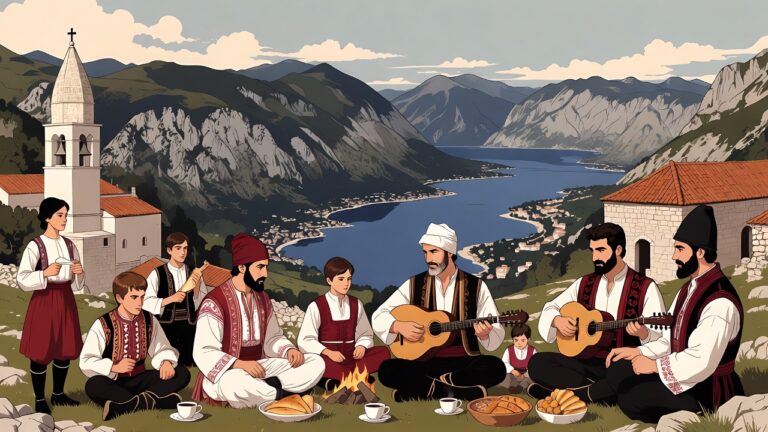
Through the Eyes of the Montenegrin
The first sound you hear as morning arrives over Kotor is the soft, deep chime of a church bell striking once from the Cathedral of Saint Tryphon, mingled with the distant lapping of the Adriatic Sea against the old walls and the scent of fresh burek and coffee drifting from a nearby café. That bell-song carries our story back to a time of mountains and sea, when we lived as the people of Crna Gora. Our ancestors built fortresses on steep cliffs like Lovćen and Kotor, grew wine and olives in fertile valleys, defended their freedom with swords and courage against Ottomans and Venetians. They lived in harmony with the mountains as father and the bay as mother: clans that worked together in bratstvo (brotherhood), songs that sang of heroes, communities where hospitality was sacred and the bond stronger than size. Every family knew the tales of Njegoš and Marko Miljanov, the feasts where everyone danced the oro in circles, the pride that grew from centuries of resistance. That was our golden time: a small land of fjords and mountains, where people lived with freedom as law and nature as ally, connected by song and honor.
But then came the wave from outside, like a storm rising from south and east. The Ottomans tried to conquer us for centuries, but we held firm in the mountains. The Austrians and Italians seized us in the world wars, the Yugoslav federation held us after 1918, the Tito era brought repression and censorship. Every family knew the loss: a grandfather who fought in the guerrilla, a brother who vanished in prison, a child who learned freedom always costs fighting. Independence in 2006 brought hope, but also the trials of a young nation: emigration of youth, economic pressure, memory of the wars in the 1990s.
From that depth rises a pride that is deep and rebellious. The bells that still ring in the old towns, the burek prepared with love, the dances that fill the night with rhythm. Our people laughing through hardship, our youth dreaming of a better land, our bond stronger than size. We have found our voice again: independence, hope growing in the bays.
Yet the truth colors magenta like a sunset over the Bay of Kotor. The scars remain: memories of occupations, emigration of youth, pressure of a fast-changing world on a small land. The outside world buys our tourism and our calm, but often does not feel the depth of a people who never broke.
Still, we remember in silence: on the squares where dancing sounds, during Independence Day on 21 May when we raise our flag, in the mountains where the spirits still speak – never forgetting who we were. We tell our children of Njegoš and of independence, of the sea and the mountains, so they know: we were connected and strong before we were challenged.
And yet… the bell-song continues, clear and persistent, like a promise that the bay always breathes again. That is our secret: we have suffered under occupations and unrest, but first we were a land of mountains and sea. For our children we build no walls, but a bay where everyone may sail. How do we let that bell-song bring freedom to everyone again? How does Montenegro remain a home of courage and horizon?
January 2026