
Through the Eyes of the Pole
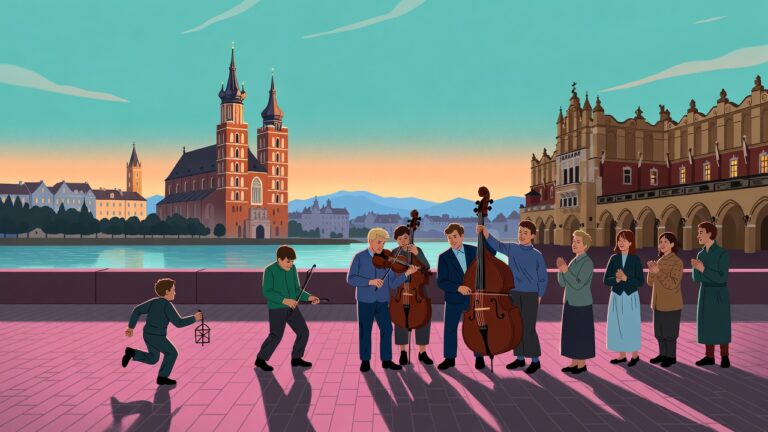
The first sound you hear as morning arrives over Kraków is the soft, deep chime of a church bell striking once from St. Mary's Basilica on the Rynek Główny, mingled with the distant hum of a street orchestra and the scent of fresh obwarzanek and coffee drifting from a nearby café. That bell-song carries our story back to a time of castles and plains, when we lived as the people of Poland. Our ancestors built Wawel and Malbork, cities like Gdańsk and Wrocław with markets that connected the world, wrote Europe's first constitution in 1791. They lived in harmony with the Vistula as mother and the Carpathians as father: farmers who tended their land with care, poets like Mickiewicz who touched the soul, communities where tolerance and diversity flourished in the Polish-Lithuanian Commonwealth. Every family knew the feasts of Dożynki celebrating the harvest, the tales of Jan III Sobieski who saved Vienna, the bond stronger than borders. That was our golden time: a land of plains, rivers, and forests, where people lived with history as guide and freedom as promise, connected by culture and courage.
But then came the wave from outside, like a storm rising from all directions. The partitions of 1772, 1793, and 1795 carved us into three, erased us from the map for 123 years. The uprisings of 1830 and 1863 were drowned in blood, Nazi occupation in 1939–1945 brought Auschwitz and millions dead, Soviet dominance after 1945 brought repression and martial law in 1981. Every family knew the loss: a grandfather in Auschwitz, an uncle in the resistance, a child who learned freedom was forbidden. The smell of smoke, the silence after tanks, the emptiness in the streets of Warsaw.
From that depth rises a pride that is deep and resilient. The church bells that still ring, the pierogi prepared with love, Solidarność that showed the world a people can rise. Our people laughing through hardship, our youth rising for a better land, our bond stronger than history. We have found our voice again: the fall of communism in 1989, EU accession in 2004, hope growing in the cities.
Yet the truth colors magenta like a sunset over the Vistula. The scars remain: memory of the partitions and the Holocaust, emigration of youth, political tensions that sometimes return. The outside world buys our history as tourism, but often does not feel the depth of a people who never broke.
Still, we remember in silence: on the squares where music sounds, during Independence Day on 11 November when we raise our flag, in the castles where the spirits still speak – never forgetting who we were. We tell our children of Sobieski and of Wałęsa, of the river and the plains, so they know: we were connected and strong before we were challenged.
And yet… the bell-song continues, clear and persistent, like a promise that Poland always rises again. That is our secret: we have suffered under partitions, occupations, and oppression, but first we were a land of freedom and culture. For our children we build no walls, but a square where everyone may gather. How do we let that bell-song bring hope to everyone again? How does Poland remain a home of courage and unity?
January 2026
Manna Ori
Oczami Polaka
Pierwszy dźwięk, który słyszysz, gdy poranek nadciąga nad Kraków, to miękki, głęboki dźwięk dzwonu kościelnego bijącego raz z Bazyliki Mariackiej na Rynku Głównym, zmieszany z odległym szumem ulicznej orkiestry i zapachem świeżego obwarzanka i kawy unoszącym się z pobliskiego domu. Ten dźwięk dzwonów niesie naszą historię z powrotem do czasów zamków i równin, gdy żyliśmy jako naród Polski. Nasi przodkowie budowali Wawel i Malbork, miasta jak Gdańsk i Wrocław z rynkami łączącymi świat, napisali pierwszą konstytucję Europy w 1791 roku. Żyli w harmonii z Wisłą jako matką i Karpatami jako ojcem: chłopi dbający o ziemię z troską, poeci jak Mickiewicz dotykający duszy, społeczności, w których tolerancja i różnorodność kwitły w Rzeczypospolitej Obojga Narodów. Każda rodzina znała święta Dożynek celebrujące żniwa, opowieści o Janie III Sobieskim, który ocalił Wiedeń, więź silniejszą niż granice. To był nasz złoty czas: kraj równin, rzek i lasów, gdzie ludzie żyli z historią jako przewodnikiem i wolnością jako obietnicą, połączeni kulturą i odwagą.
Ale potem nadeszła fala z zewnątrz, jak burza wschodząca ze wszystkich stron. Rozbiory w 1772, 1793 i 1795 rozdarły nas na trzy, wymazały z mapy na 123 lata. Powstania 1830 i 1863 utopiono we krwi, okupacja nazistowska w 1939–1945 przyniosła Auschwitz i miliony ofiar, dominacja sowiecka po 1945 represje i stan wojenny w 1981. Każda rodzina znała stratę: dziadek w Auschwitz, wujek w oporze, dziecko uczące się, że wolność jest zakazana. Zapach dymu, cisza po czołgach, pustka na ulicach Warszawy.
Z tej głębi rodzi się duma głęboka i odporna. Dzwony, które wciąż dzwonią, pierogi przygotowane z miłością, Solidarność, która pokazała światu, że naród może powstać. Nasi ludzie śmiejący się przez trudności, nasza młodzież powstająca dla lepszego kraju, nasza więź silniejsza niż historia. Odzyskaliśmy głos: upadek komunizmu w 1989, wejście do UE w 2004, nadzieja rosnąca w miastach.
Jednak prawda barwi się na magenta jak zachód słońca nad Wisłą. Blizny pozostają: pamięć o rozbiorach i Holokauście, emigracja młodzieży, napięcia polityczne, które czasem wracają. Świat zewnętrzny kupuje naszą historię jako turystykę, ale często nie czuje głębi narodu, który nigdy nie pękł.
Mimo to pamiętamy w ciszy: na rynkach, gdzie brzmi muzyka, podczas Dnia Niepodległości 11 listopada, gdy wznosimy flagę, w zamkach, gdzie duchy wciąż mówią – nigdy nie zapominamy, kim byliśmy. Opowiadamy dzieciom o Sobieskim i o Wałęsie, o rzece i równinach, by wiedziały: byliśmy połączeni i silni zanim nas wyzwano.
A jednak… dzwony trwają, jasne i wytrwałe, jak obietnica, że Polska zawsze powstaje na nowo. To nasza tajemnica: cierpieliśmy pod rozbiorami, okupacjami i represjami, ale najpierw byliśmy krajem wolności i kultury. Dla naszych dzieci nie budujemy murów, lecz rynek, gdzie wszyscy mogą się zejść. Jak sprawić, by ten dźwięk dzwonów znów przyniósł nadzieję wszystkim? Jak Polska pozostaje domem odwagi i jedności?
Styczeń 2026
Manna Ori