Through the Eyes of the Ugandan
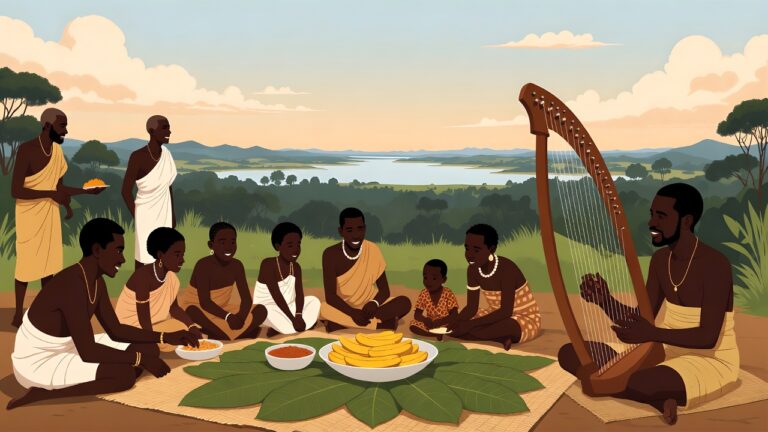
The first sound you hear as morning arrives over Kampala is the soft, rhythmic pluck of a single string on anadungu (harp), blended with the distant call of an ibis along Lake Victoria and the aroma of fresh matooke(steamed bananas) with groundnut sauce drifting from a nearby home. That harp sound carries our story back toa time of lakes and hills, when we lived as the peoples of Uganda: the Baganda, Banyankole, Basoga, Acholi,Langi, Lugbara, and many others. Our ancestors built kingdoms such as Buganda with palaces on the hills, grew bananas and coffee in fertile soil, fished with canoes on Lake Victoria. The Baganda knew their kabaka (king)and their clan systems, the Banyankole their cattle and milk ceremonies, the Acholi their lararakaraka dances.Every family knew the stories of the ancestors, the harvest feasts where all came together, the bond stronger than differences. That was our golden time: a land of lakes, hills, and jungle, where people lived in harmony withLake Victoria as mother and the mountains as father, connected through rhythm, cattle, and hospitality.
But then came the wave from outside, rising like a storm from the north and east. The British colonised us in the19th century, calling us the Uganda Protectorate and turning us into a source of coffee and cotton. Every family knew the loss: an ancestor who laboured for strangers, a child forced to speak English at school, a culture forced to adapt. Independence in 1962 brought Milton Obote—hope that grew—but also the dictatorship of Idi Amin(1971–1979) with tens of thousands killed, tortured, and disappeared. The years that followed: Obote II,Museveni's guerrilla war, the Lord's Resistance Army in the north that abducted children and terrorised villages.Every family knew the pain, the disappearances, the emptiness in the villages of Gulu.
From that depth rises a pride that is warm and resilient. The adungu still plays in the villages, matooke preparedwith love, the boda-boda filling the streets with life. Our people laugh through hardships, our young rise for abetter country, our bonds stronger than the pain. We have reclaimed our voice: the peace after the LRA in 2006,the hope growing around Lake Victoria.
Yet the truth colours magenta like a sunset over Lake Victoria. The scars remain: the memory of Amin and theLRA, poverty in the villages, the emigration of youth, the pressure of climate change on our fisheries. The outside world buys our coffee and our tourism, but often fails to feel the depth of a people that never broke.
Still, we remember in silence: around the adungu where music is born, on Independence Day the 9th of October when we raise our flag, along the lake where spirits still speak—never forgetting who we were. We tell our children of the ancient kingdoms and of the peace, of the lake and the hills, so they know: we were connected and strong before the challenges came.
And yet… the adungu continues, soft and deep, like a promise drifting over the hills. That is our secret: we have suffered under colonisation, dictatorship, and war, but first we were a land of lakes and rhythm. For our children we build no walls, but a lake where everyone may fish. How do we let that harp sound bring hope once more to all? How does Uganda remain a home of unity and laughter?
January 2026
Manna Ori