Through the Eyes of the Brit
The first sound you hear as morning arrives over London is the soft, persistent chime of Big Ben striking once, blended with the distant murmur of the Thames and the aroma of fresh fish and chips with vinegar drifting from a nearby café. That clock sound carries our story back to a time of sea and green hills, when we lived as the people of Great Britain. Our ancestors built Stonehenge to honour the sun, the Romans brought roads and baths, the Anglo-Saxons wrote Beowulf, the Normans raised castles like the Tower of London. We lived in harmony with the sea as mother and the hills as father: farmers who tilled their land, poets like Shakespeare who touched the soul, sailors who traversed the world with the Royal Navy. Every family knew the feasts of Guy Fawkes Night where fireworks filled the sky, the tales of King Arthur and Robin Hood, the bond stronger than time. That was our golden time: a land of sea, hills, and rivers, where people lived with the horizon as promise and freedom as compass, connected through language, law, and adventure.
But then came the wave from outside, rising like a storm from the past. The Romans, Vikings, and Normans invaded, the world wars cost millions of lives, the Blitz devastated cities. Every family knew the loss: a grandfather in the trenches of the Somme, a grandmother in the shelter during the Blitz, a child taught that freedom costs blood. Decolonisation after the Second World War ended the British Empire, waves of immigration changed our cities, Brexit in 2016 tore the country in two. Every family knew the pain, the division, the emptiness in the streets of London.
From that depth rises a pride that is calm and down-to-earth. Big Ben still chimes, fish and chips prepared with care, tea that steadies the world. Our people weather storms with a cuppa, our young rise for a better country, our bonds stronger than history. We have reclaimed our voice: the Commonwealth that endures, the hope growing along the Thames.
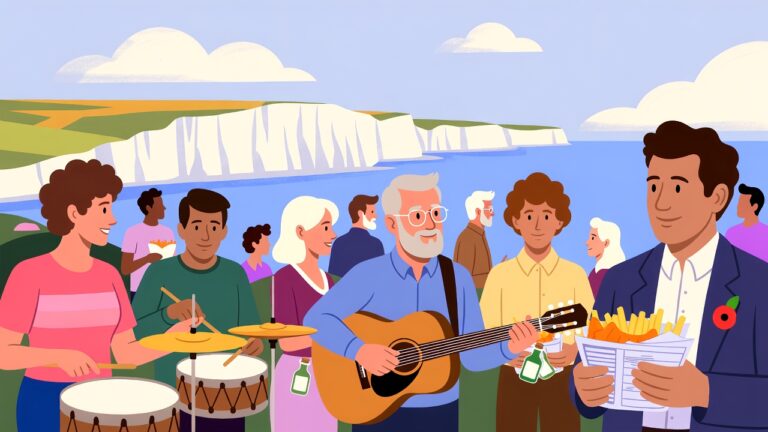
Yet the truth colours magenta like a sunset over the White Cliffs of Dover. The scars remain: the memory of the world wars and the Blitz, the wounds left by decolonisation, Brexit dividing families, the emigration of youth. The outside world buys our history as tourism, but often fails to feel the depth of a people that never broke.
Still, we remember in silence: on the squares where music plays, during Remembrance Day the 11th of November when we wear our poppies, in the hills where spirits still speak—never forgetting who we were. We tell our children of the Magna Carta and the Blitz, of the sea and the hills, so they know: we were connected and strong before the challenges came.
And yet… the clock chime continues, clear and persistent, like a promise that the Thames always flows on. That is our secret: we have suffered under invasions, wars, and division, but first we were a land of sea and freedom. For our children we build no walls, but a bridge over the Thames where everyone may cross. How do we let that clock sound bring hope once more to all? How does Great Britain remain a home of level-headedness and connection?
January 2026
Manna Ori