Through the Eyes of the Emirati
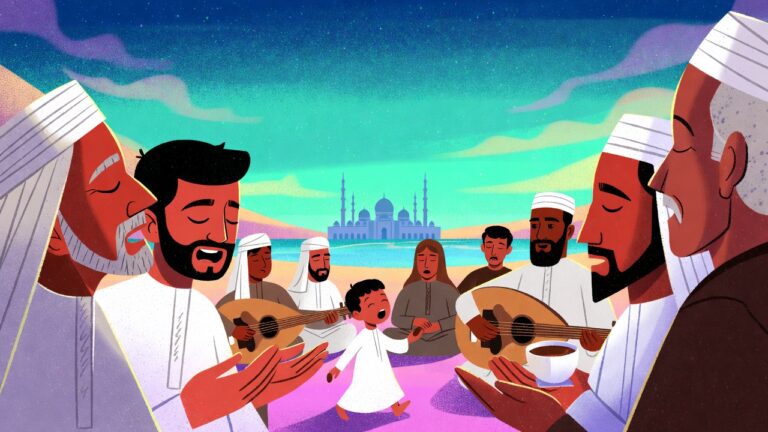
The first sound you hear as morning arrives over Abu Dhabi is the soft, persistent call of the adhan rising from the Sheikh Zayed Grand Mosque, blended with the distant hum of a dhow in the harbour and the aroma of freshArabic coffee with cardamom and dates drifting from a nearby majlis. That call carries our story back to a time of sea and desert, when we lived as the peoples of the Emirates: the Bani Yas, Al Nahyan, Al Maktoum, and other tribes. Our ancestors dived for pearls with dhows in the Gulf, built small forts along the coast like Al Jahili in AlAin, herded camels through the dunes of the Rub' al-Khali. They lived in harmony with the desert as mother and the sea as father: Bedouins who honoured their camels, pearl divers who read the sea like a book, communities where the majlis was the place of stories, counsel, and hospitality. Every family knew the feasts of Eid where all gathered, the tales of ancient traders, the bond stronger than the heat. That was our golden time: a land of pearls and sand, where people moved with the wind as brother and the stars as guide—free and connected through majlis and honour.
But then came the wave from outside, rising like a storm from the desert. The Portuguese, Ottomans, and British tried to control us for centuries, making us a protectorate in 1820 with the Perpetual Maritime Truce. Every family knew the loss: an ancestor who dove pearls until the market collapsed, a child taught that wealth does not always bring freedom, a culture forced to adapt to British influence. The discovery of oil in 1958 changed everything: Sheikh Zayed and Sheikh Rashid united the emirates in 1971 into the UAE, bringing wealth and modernisation. Every family knew the rapid change, the hope of a new beginning, the silence in the old villages.
From that depth rises a pride that is deep and welcoming. The majlis where coffee is still brewed and storiesshared, the dhows still sailing along the coast, the pearls reminding us of our past. Our people laugh through hardships, our young dream of a better nation, our bonds stronger than oil. We have reclaimed our voice: the renaissance under Sheikh Zayed, the hope growing in the cities.
Yet the truth colours magenta like a sunset over the Liwa oasis. The scars remain: the memory of colonial times,the pressure of modernisation on tradition, the emigration of youth, the dependence on oil. The outside world buys our oil and our tourism, but often fails to feel the depth of a people that never broke.
Still, we remember in silence: around the majlis where tea is poured, on National Day the 2nd of December when we raise our flag, in the desert where spirits still speak—never forgetting who we were. We tell our children of theold pearl divers and of Sheikh Zayed, of the sea and the desert, so they know: we were connected and strongbefore the challenges came.
And yet… the adhan continues, warm and persistent, like a call drifting over the desert. That is our secret: we have suffered under colonisation, change, and dependence, but first we were a land of pearls and sea. For our children we build no walls, but a majlis where everyone is welcome. How do we let that adhan sound bring unity once more to all? How does the UAE remain a home of hospitality and resilience?
January 2026
Manna Ori