Through the Eyes of the American
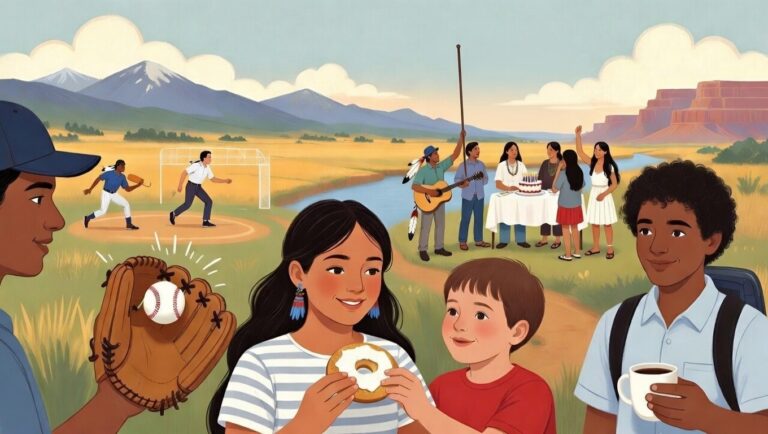
The first sound you hear as morning arrives over New York is the soft, persistent smack of a baseball hitting a glove in a park, blended with the distant rumble of the subway and the aroma of fresh bagels with cream cheese and coffee drifting from a street cart. That sound carries our story back to a time of prairies and freedom, when we lived as the peoples of America: the Native Americans – Cherokee, Navajo, Lakota, Iroquois, and many others – who had inhabited the continents for millennia. Our ancestors built pueblos in the desert, longhouses in the forests, tipis on the plains, living in harmony with the earth as mother and the buffalo as brother. They knew the stories of the Great Spirit, the ceremonies of the Sun Dance and Powwow, the bond stronger than borders. Every family knew the routes of the buffalo, the feasts where all danced, the freedom that grew from respect for nature. That was our golden time: a continent of mountains, prairies, and rivers, where people lived with the horizon as promise and nature as guide, connected through stories and respect.
But then came the wave from outside, rising like a storm from the ocean. Europeans arrived in the 15th century with Columbus, bringing diseases that killed millions, taking our land through broken treaties, forcing us onto reservations. Every family knew the loss: an ancestor driven on the Trail of Tears, a child taught that freedom was forbidden, a culture held in secret. Independence in 1776 brought freedom for some, but slavery for others, the Civil War cost 600,000 lives, Jim Crow laws divided us, the internment of Japanese Americans in WWII, the civil rights struggle of Martin Luther King. Every family knew the pain, the division, the emptiness in the streets of Selma and Birmingham.
From that depth rises a pride that is deep and resilient. The baseball still played on every field, jazz and blues that made the world swing, barbecues prepared with love. Our people laugh through hardships, our young rise for a better country, our bonds stronger than history. We have reclaimed our voice: the civil rights movement, the hope growing in the cities.
Yet the truth colours magenta like a sunset over the Grand Canyon. The scars remain: the genocide of Native Americans, slavery and segregation, poverty on reservations, tensions that sometimes return. The outside world buys our culture as entertainment, but often fails to feel the depth of a people that never broke.
Still, we remember in silence: around the fire where stories are told, on Independence Day the 4th of July when we raise our flag, in the prairies where spirits still speak—never forgetting who we were. We tell our children of the Founding Fathers and of Martin Luther King, of the prairies and the mountains, so they know: we were connected and strong before the challenges came.
And yet… the baseball game continues, clear and rhythmic, like a promise that the field always stays open. That is our secret: we have suffered under colonisation, slavery, and division, but first we were a land of prairies and freedom. For our children we build no walls, but a baseball field where everyone may play. How do we let that crack of the bat bring hope once more to all? How does America remain a home of diversity and resilience?
January 2026
Manna Ori