Through the Eyes of the Yemeni
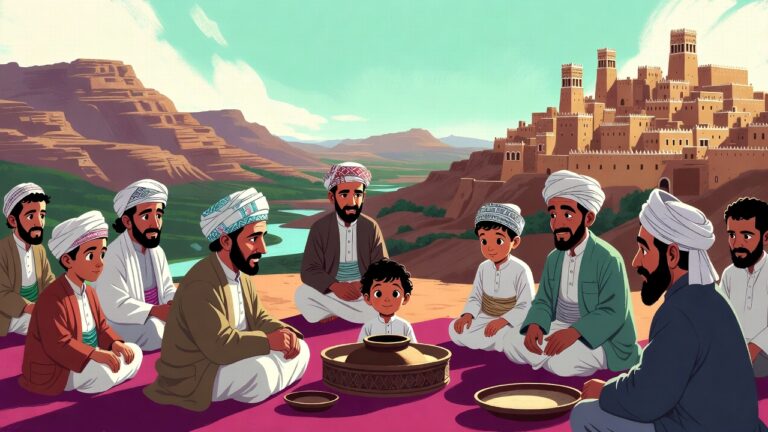
The first sound you hear as morning arrives over Sana'a is the soft, persistent call of the adhan rising from an ancient minaret, blended with the distant bleat of a goat on the rooftops and the aroma of fresh qishr (coffee husk tea) and malawah (flatbread) drifting from a nearby home. That call carries our story back to a time of terraces and caravans, when we lived as the people of Yemen. Our ancestors built the old city of Shibam with mud towers that seemed to touch the sky, drove frankincense trade along caravan routes from Hadramaut to the Mediterranean, grew qat and coffee on the terraces of the highlands. The Sabaeans, Himyarites, and later Islamic kingdoms flourished with knowledge and commerce, poets sang qasidas of love and honour, communities lived in harmony with the mountains as father and the desert as mother. Every family knew the feasts of Eid where all gathered, the stories of Bilqis the Queen of Sheba, the bond stronger than drought. That was our golden time: a land of mountains, wadis, and sea, where people lived with frankincense as wealth and hospitality as law, connected through poetry, trade, and faith.
But then came the wave from outside, rising like a storm from the desert and the sea. The Ottomans, the British in Aden, the North-South division after independence in 1967, the unification in 1990 that brought hope but also tensions. Every family knew the loss: an ancestor who fought in uprisings, a child taught that freedom is fragile, a culture forced to adapt to wars. The civil war from 2014 – Houthis, Saudi coalition, Emiratis, Al-Qaeda – devastated everything: millions displaced, hunger, cholera, cities like Taiz and Hodeidah in ruins. Every family knew the pain: a brother fallen, a mother waiting for aid that never came, a child growing up in a camp.
From that depth rises a pride that is deep and welcoming. The adhan still echoes in the mosques, qishr brewed with love, the terraces still yielding rice and qat. Our people laugh through pain, our young rise for a better country, our bonds stronger than war. We have reclaimed our voice: the hope that still burns in the mountains, the unity that sometimes returns.
Yet the truth colours magenta like a sunset over the old city of Sana'a. The scars remain: the war that continues, hunger gripping millions, the emigration of youth, the destruction of our heritage. The outside world buys our coffee and our history, but often fails to feel the depth of a people that never broke.
Still, we remember in silence: around the majlis where qishr is poured, on Independence Day the 30th of November when we raise our flag, in the wadis where spirits still speak—never forgetting who we were. We tell our children of the ancient kingdoms and of the hope for peace, of the sea and the mountains, so they know: we were connected and strong before the challenges came.
And yet… the adhan continues, warm and persistent, like a call drifting over the mountains. That is our secret: we have suffered under colonisation, wars, and hunger, but first we were a land of frankincense and poetry. For our children we build no walls, but a majlis where everyone is welcome. How do we let that adhan sound bring hope once more to all? How does Yemen become once more a home of unity and peace?
January 2026
Manna Ori